

Meta markets their smart glasses around a simple idea: “The best things in life are hands-free.” Their latest patent reveals just how much Meta wants those glasses to do for you. It describes smart cameras connected to an AI assistant capable of recognising the people around the wearer, analysing their expressions and actions, tracking what catches the wearer’s attention and deciding which people or objects are interesting enough to capture. A fashionable accessory, while surveillance moves with the person wearing the glasses.
Filed on 4th February 2026 by Meta Platforms Technologies, LLC, and published on 13th August 2026, US 2026/0238876 A1, “Smart Cameras Enabled by Assistant Systems,” describes an AI-assisted camera system combining visual information with capabilities including facial recognition, facial-expression analysis, sensory data, gaze detection and object recognition. Not one of these technologies individually is so futuristic, however, what happens when an AI assistant combines them ranked by its own training?
The wearer may be the customer, but most of the people being filmed by the AI system never consented to being recorded.
Disclaimer: This investigation is based on publicly available information, patents, reporting and regulatory sources. Patented, experimental or licensed capabilities do not de facto establish current deployment or future commercial release. Potential misuse and surveillance implications are analysis of documented capabilities. The author’s opinions are explicitly stated. Readers are encouraged to review the sources and form their own conclusions.
MEASURING INTERESTINGNESS
No, this is not just “facial recognition”. I will try to strip the patent from the technical language and explain it with examples directly taken from it, as how the AI assistant processes and what it can do with the information collected from the cameras on the smart glasses.
The AI system operates reactively, when a wearer asks it to take a photograph or record something, but it can also act proactively. Meta describes an auto-capture mode in which the assistant automatically detects people and objects within the camera’s field of view and records them. A wearer could simply ask the assistant to “capture the best moments of this party” and leave the system to determine what those moments are.
To make that decision, the assistant identifies “points of interest” and assigns people and objects a “measure of interestingness.” That assessment can draw on several different signals.
One is identity. The patent describes facial recognition working with several people in view, while they are moving, from different angles and even at distances such as across a room. Recognition can also take place on the device itself. Once people are identified, their identity can influence how interesting the system considers them.
Meta gives a simple example: the camera detects a user’s son alongside his teachers. Because facial recognition identifies the son, the system gives him a higher measure of interestingness and selects him as the point of interest.
The assistant can make a similar judgment without knowing someone’s identity. It can analyse facial expressions and use them to determine who deserves attention. In Meta’s example, 3 people are detected. Two appear happy and one appears angry. The two happy people receive a higher measure of interestingness and are selected as points of interest.
On a personal note, that example is the embodiment of “rose tinted glasses”. Wonder if wearing them will erase the wearer’s view of crime, poverty or even delete their own sense of safety?
Objects are evaluated in much the same way. The patent describes a camera detecting a house, a tree and a convertible car, then determining that the convertible has the highest interestingness and making it the point of interest.
The wearer’s own behaviour becomes another signal. Eye-gaze tracking can tell the assistant what the wearer is looking at. If someone wearing the glasses stares at a dog, for example, the system can interpret that gaze as evidence of interest and select the dog as the point of interest.
The assistant can then use these judgments when deciding what to capture and how to frame it. If a wearer gives an ambiguous instruction such as “take a picture of that,” the system can identify what it considers the most important object in view, automatically crop the image around it and ask the wearer for confirmation.
In it also mentioned that the assistant system may automatically modify the field of view of the cameras to provide the highest-quality view for the user. It may send to the wearer instructions for zooming in one or more of the cameras to position one or more of the points of interest in the centre of the field of view.
The instructions (unspecified whether from the AI assistant or user) may enable the cameras to position multiple points of interest in the field of view so that they are centred in the wearer’s view.
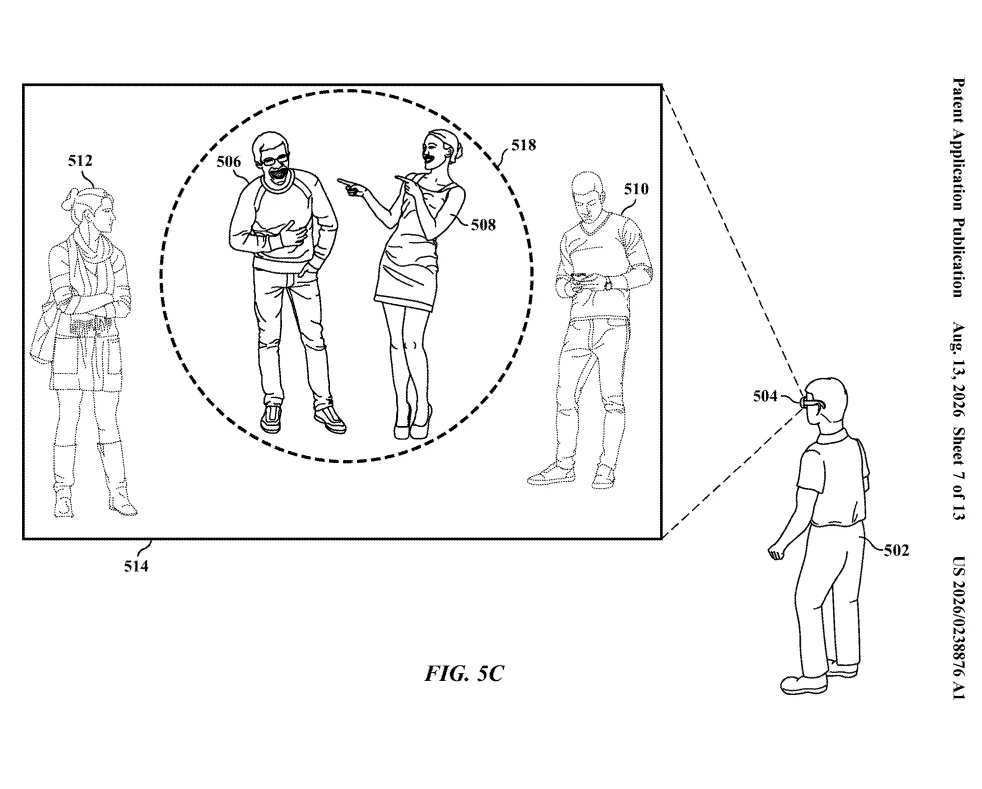
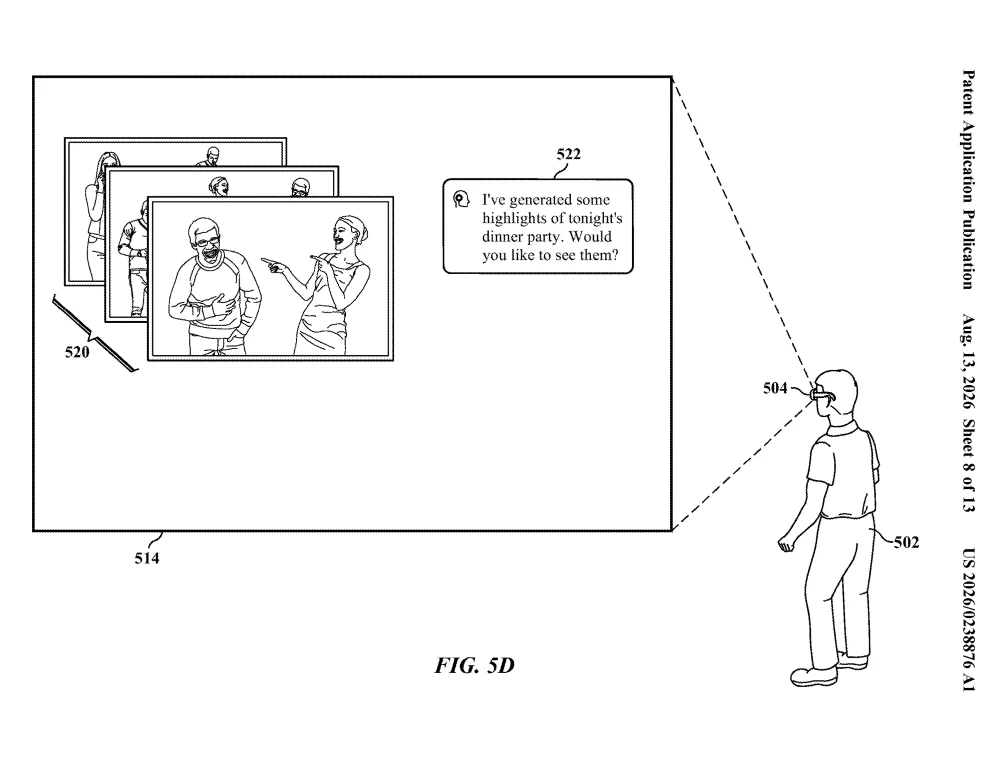
For the wearer, this could make capturing everyday moments almost effortless. The AI assistant can work out what matters instead of requiring the user to move their spatial perception or manually point, frame and record.
To oppose the cutesy examples above, these smart glasses can also help someone with stalking or even maybe, a paedophile can get a recommendation of adjusting or zoom for the central point of interest: to record and keep images of children. Not like there haven’t there already been cases of teachers being accused of CSAM or AI-generated sexual imagery from existing public photos.
I admit, that doesn’t sound good when filing a patent.
WHAT THE SMART GLASSES SEE?
How the cameras analyse the recorded data is only one part of the patent. Behind them, Meta describes the capability of combining what the smart glasses see with information it already knows about the wearer and the world around them.
The assistant can use location awareness and access information from online sources, including weather, traffic, news, schedules and retail information. It can receive text, voice, images, video, gestures, motion and other forms of input, then use them together to understand what the wearer wants or what is happening around them.
The patent describes an assistant capable of performing services on the wearer’s behalf, such as making restaurant reservations, purchasing event tickets or arranging travel. It can manage tasks using online information and events and, in some circumstances, act without the wearer initiating the action.
The assistant may create and store a user profile containing both personal and contextual information about the wearer. That information can then be used to provide what the patent calls more “personalized and context-aware understanding.”
The patent also describes the assistant in connection with a social-networking system. That system may maintain a user profile containing demographic information, communication information and personal interests. It may also store a record of the wearer’s relationships with other users.
This means the assistant is not interpreting information from the glasses without context. It is a part of a system that already contains information about the wearer, their interests and their relationships with other people.
That makes Meta’s earlier example of identifying the wearer’s son among his teachers more significant. The camera can provide information about who is physically in front of the wearer, while the wider system described in the patent can contain information about who those people are in relation to the wearer.
The patent goes further by describing an assistant that can proactively execute tasks relevant to the wearer’s interests and preferences based on their profile, at a time it considers relevant to them.
Processing is not necessarily confined to the glasses or phone either. Meta describes a hybrid architecture split between client-side and server-side processing. Some tasks can be performed locally on the wearer’s device, while others can be processed remotely on computing systems, with the system determining whether to use one, the other or both.
Meta presents this architecture as a way to make efficient use of computing resources while protecting privacy and improving security, while the patent repeatedly refers to privacy settings governing access to user information.
HOW IS PRIVACY HANDLED?
The patent goes lengths about safeguards for how information can be handled. It says considerably less about whether the person being observed gets a say before that information is created at all.
At the broadest level, information handled by the assistant or social-networking system can be attached to privacy settings governing how it may be accessed, stored, viewed, shared, modified, copied, surfaced or identified. Users of the smart glasses can also create blocked lists preventing particular people or 3rd parties from accessing certain information.
The patent gives location data as one example. A user could allow their location to be used for recommendations while preventing Meta’s systems from storing that location or providing it to a 3rd party.
Biometric information receives more specific restrictions. The patent describes personal or biometric information being used for purposes such as authentication or personalisation only when the user chooses to use those functions. Privacy settings can restrict biometric information to a specific purpose and prevent it from being shared with third parties or used by other applications or processes.
One example involves a facial profile or retinal scan. A user could provide that reference image for a limited purpose such as authentication or photo tagging while prohibiting its use elsewhere. Let Meta have a retinal scan that is unique to each person.
Identity resolution also has privacy controls. If another user has specified that their identity should not be searchable on the social network, the assistant’s entity-resolution system is supposed to respect that restriction and not return that person’s identifier.
So, on paper, the patent provides several layers of protection: control over access and storage, opt-in and opt-out mechanisms, restrictions on logging and 3rd party sharing, purpose limitations for biometric information, limits on identity resolution and privacy settings applied to facial and facial-expression recognition.
There is, however, an important limitation. Most of those protections are described from the perspective of a user whose information already exists within Meta’s system.
The smart classes can detect several people simultaneously, recognise faces from different angles and across a room, analyse facial expressions and use those results to decide who becomes a point of interest.
The patent explicitly places those functions under privacy settings, but it does not clearly explain what happens when the person being analysed has no Meta account, no relevant privacy settings and no relationship with their system at all.
For a stranger walking through or anyone in the glasses’ field of view, the patent has no explicit stance on consent for being recorded.l Also, there are several issues I could not find specified in the patent: a defined retention period for biometric information captured about bystanders, a requirement to immediately delete unidentified facial data, or a dedicated mechanism allowing a non-user to discover and remove biometric information created about them.
META’S HISTORY, THEN MAKE IT FASHIONABLE
Meta has a history and a not so shiny reputation with facial recognition. Ignoring all other lawsuits, only focusing on a few that are connected to this topic specifically. Facebook settled a major class-action lawsuit for $650 million after being accused of violating the Illinois Biometric Information Privacy Act (BIPA). The lawsuit claimed that Facebook’s “Tag Suggestions” tool used facial recognition technology to scan and store user face templates without proper written consent.
In 2021, Meta announced that Facebook’s Face Recognition system would be shut down and that more than one billion individual facial-recognition templates would be deleted. Meta itself cited growing societal concerns surrounding facial recognition and uncertainty over appropriate regulation when announcing the decision, as privacy worries, regulatory scrutiny and legal settlements just kept on pilling.
Three years later, Meta agreed to a $1.4 billion settlement with Texas over allegations that Facebook had captured and used biometric information without the authorization required under state law.
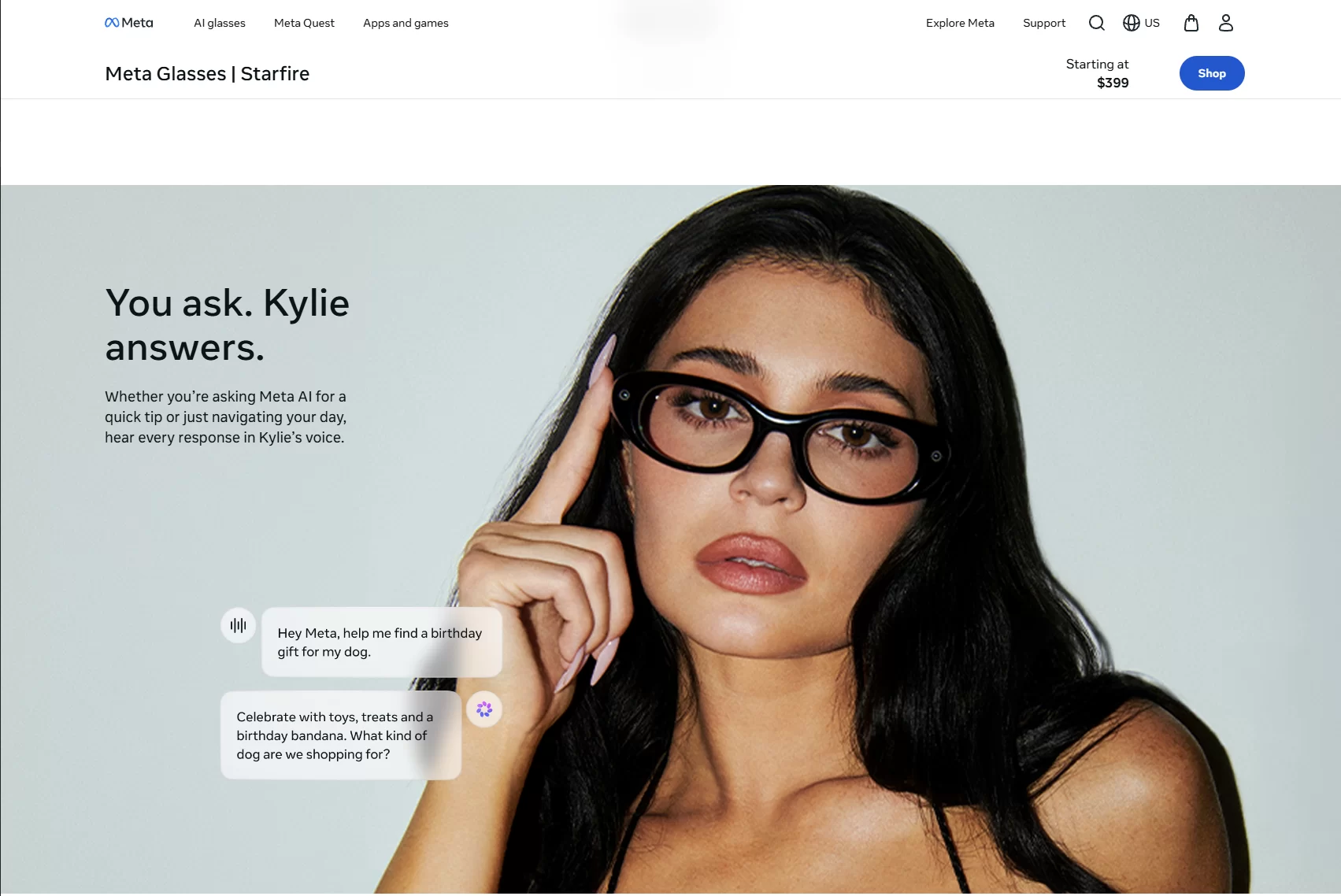
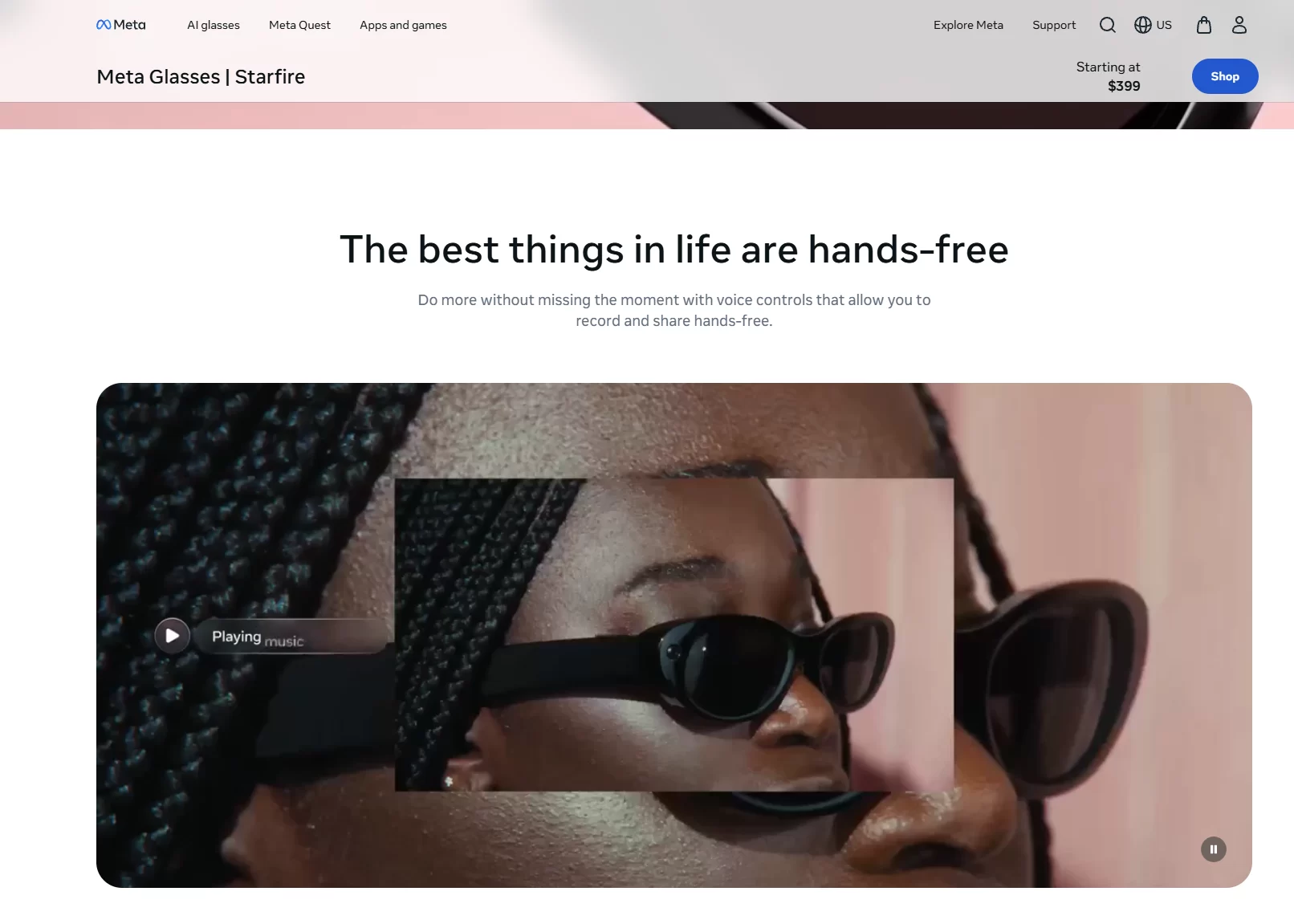
And in 2026, facial recognition moved into Meta’s smart glasses. How did the company approach gaining trust among customers? By collaborating with influencers and celebrities, like Kylie Jenner. To that, I can only say it convinced me that surveillance can be a new fashion trend, as these screenshots from their website present.
NAMETAG & MORE LICENCING
In June 2026, WIRED reported discovering an unreleased facial-recognition system called “NameTag” inside Meta AI, the companion application used with Meta’s smart glasses.
The system was not active for consumers. However, code examined by WIRED showed that NameTag had been designed to identify people captured by the glasses and compare biometric information derived from their faces against information stored on the wearer’s phone. When a person was recognised, the system could alert the wearer.
The system also contained components for detecting faces, cropping them and converting them into biometric representations. Unrecognised faces are particularly relevant to the privacy discussion. According to WIRED’s analysis, they could be cropped and indexed for later processing rather than simply disappearing because the system did not know who they belonged to.
One day after WIRED reported on NameTag, Meta removed the unactivated facial-recognition components from the application. Meta described its facial-recognition work as exploratory and maintained that no final decision had been made about whether such functionality would become a consumer product.
Another WIRED investigation in June 2026 found that Meta had also licensed facial-recognition technology from Rank One Computing (ROC) for testing related to its smart glasses. ROC is a US biometrics company that supplies facial-recognition technology to law-enforcement, government and military customers. One of them being the Pentagon, who is on a rampage of signing billion-dollar classified contracts with AI and BigTech companies, for surveillance, defence and military applications.
The expansion has already pushed workers elsewhere in the industry past internal dissent and into organising, with Google employees unionising in response to the company’s growing military work that costs human lives.
The licence from ROC covered both facial recognition and liveness detection, which is designed to determine whether a camera is looking at a real person rather than a photograph, mask or another representation. The technology was integrated into a test version of the Meta AI app and, like NameTag, was inactive for consumers.
ROC’s integration was discovered in the Meta AI app on June 4th. Meta released an update removing the facial-recognition code on June 5th, after WIRED approached the company and published its findings.
META AND PERSISTANCE
For legal purposes I have to repeat this again: there is no evidence that Meta deployed ROC’s surveillance technology to people already using the glasses.
A patent protects inventions and potential implementations. It is not a product announcement and companies routinely patent technologies that never reach consumers. Likewise, dormant code found inside an application does not mean a feature is operational and an internal software licence does not establish that the licensed technology will appear in a commercial device.
At time of writing, there is no basis for claiming that Meta’s consumer smart glasses are secretly performing everything described in this patent or the licence from ROC.
What I’m pointing to here is Meta’s determination. The patent, the licensing and the repeated experimental features show a company actively exploring multiple routes to develop, test and legally protect the same underlying capability. None of that proves a consumer rollout, but taken together, it is difficult to dismiss as casual experimentation or lacking involvement in the current AI arms race.
THE REGULATORY PROBLEM
Let’s look into the complexity and what fields of regulations the smart glasses already on the streets have to deal with firstly. So, they can capture video, audio and information about the environment around their wearer. That includes privacy, data-protection, recording and consumer-protection laws, then how that information is collected, processed and transferred. On top of that, this is wearable technology.
In the United States, the main problem is fragmentation. There is no single comprehensive federal biometric privacy law. Instead, requirements vary by state, with some jurisdictions imposing specific rules on the collection, use, disclosure and retention of biometric identifiers while others provide far less protection.
In case of the patent, legal obligations would change depending on the jurisdiction.
The European Union has a more unified framework. Meta’s existing glasses already fall within the GDPR whenever Meta processes personal data within its scope. Images, recordings, location information and other identifiable data can constitute personal data, while biometric data used for uniquely identifying someone is treated as a special category of personal data and receives stricter protection.
If the patent’s facial-recognition capabilities were deployed, Meta would therefore need to address lawful basis, transparency, purpose limitation, data minimisation, retention, security and the additional restrictions applying to biometric identification.
In August 2026, the AI Act came in force, which Meta’s glasses fall under. Biometric AI systems fall into high-risk categories depending on their purpose and use, bringing requirements around risk management, documentation, data governance, transparency, human oversight, accuracy, robustness and cybersecurity.
The AI Act places particular limits on certain forms of biometric categorisation, remote biometric identification and emotion recognition. And if you remember the example above from the patent that classifies people as appearing happy, angry or otherwise emotionally expressive, that would fall into severely restricted or prohibited under the Act.
BEYOND META
Fashion wearables come with tags and labels telling us what they are made of. Surveillance rarely comes with a label saying “surveillance.” It arrives as convenience, personalisation, safety, memory and a camera that captures the moments that matter to you, normalising its use.
Meta’s smart glasses on the market right now already sit on top of existing hardware, software and AI infrastructure. The patent therefore does not describe a capability that would have to be invented from scratch. It describes a feature that could be (experimentally) layered onto systems already in use, whether that happens tomorrow, next year or never. If that happens, who gets to decide how far the capabilities of facial and biometric recognition can go?
The wearer gets to choose the technology and be fashionable. Everyone caught in the camera’s view are left only with blind trust that the technology, Meta or the person wearing will misuse the images and recordings.
Meta asks its customers to agree with privacy policies and terms of use. Meta never asked people like you or me whether we consent to becoming the data.