Artificial intelligence (AI) has become trapped between two competing myths, both which fall into absolutism and determinism.
On one side are the utopians, promising unprecedented prosperity, scientific breakthroughs and a future where machines handle the tedious parts of human work. On the other are the prophets of collapse and doom, warning that AI will replace workers, destabilize economies and render large portions of the population economically irrelevant.
Both narratives dominate headlines, attract attention and generate investment. And both often rely on a shared assumption: that the future of AI is already decided and we can do nothing about it. This belief has become so widespread that researchers and commentators describe it as “AI absolutism”, the idea that AI will inevitably dominate industries, transform labour markets and reshape society.
AI is already having a significant impact on society. The more interesting question is whether our understanding of the inevitability of AI is supported by evidence or by increasingly confident predictions presented as certainty.
Disclaimer: The purpose of this article is to provide context, analysis and discussion based on publicly available information. All opinions expressed are the author’s own. Readers are encouraged to consult the linked sources and referenced materials to explore the evidence and draw their own conclusions.
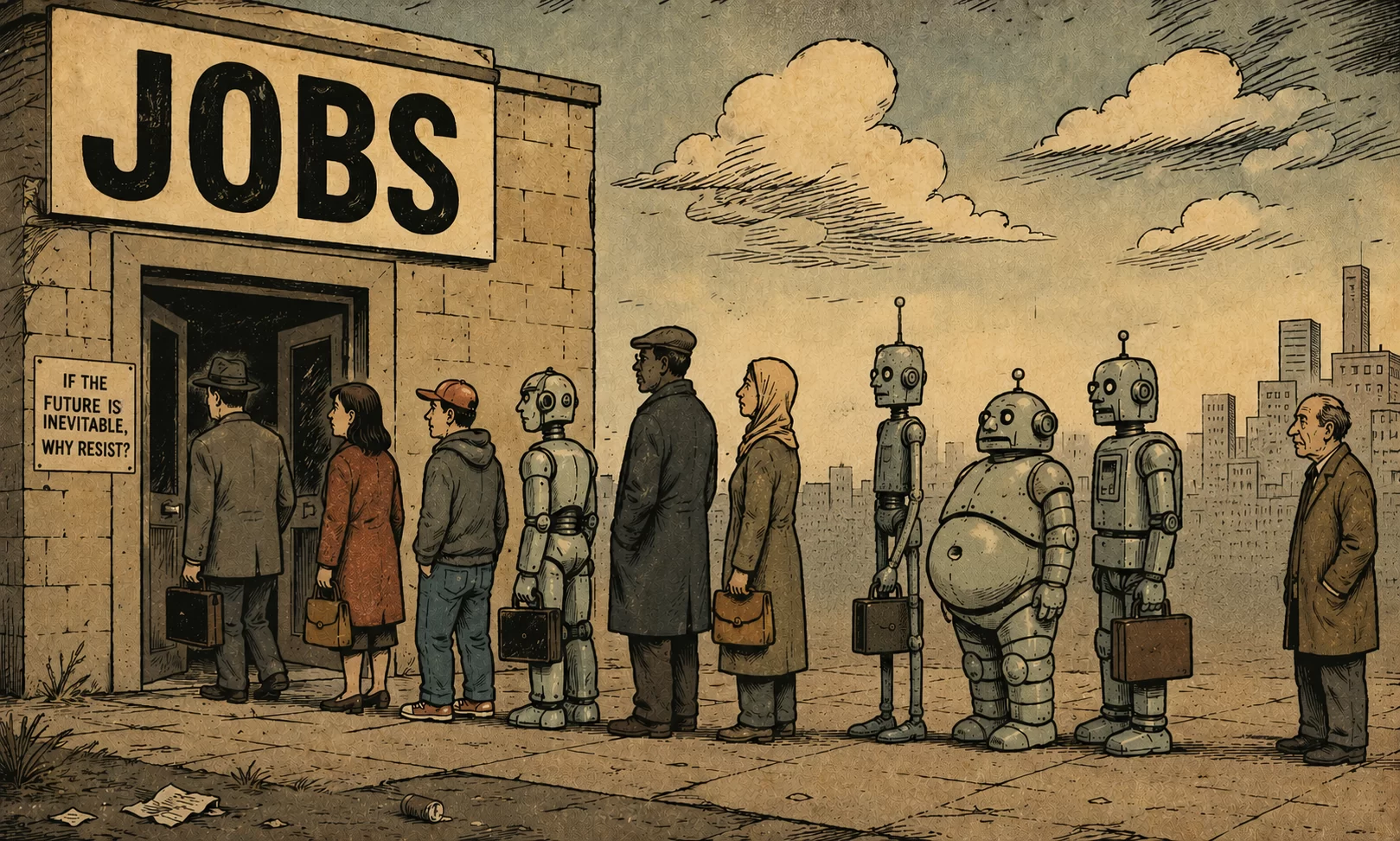
Will AI take our jobs?
The most common concerns are that AI will replace vast numbers of workers. There is a legitimate fear behind those claims.
From conference stages to earnings calls, BigTech and the most influential AI executives have warned that entire categories of employment could disappear. OpenAI CEO Sam Altman spent years discussing the disruptive potential of increasingly capable AI systems. He frequently has a dystopian rhetoric about his own product and company, to lengths such as: “AI will most likely lead to the end of the world, but in the meantime there will be great companies created with serious machine learning.”
Anthropic CEO Dario Amodei in his post “The Adolescence of Technology” from January 2026, predicts that AI could eliminate large percentages of entry-level white-collar work.
Fearmongering as a marketing department
In practice, inevitability language functions as moral evasion. Scholars have written that when policy makers present something as inevitable, it takes the responsibility away from present-day situations and turns toward abstract futures (Winner, 1986; Jasanoff, 2016). When collapse is portrayed as unavoidable, acceleration becomes the rational action to take. This framing of narrative dismisses and lowers accountability while preserving momentum. A leader cannot credibly argue that a technology may end the world while simultaneously expanding its deployment across public and private institutions. One of these positions must be rhetorical rather than real.
Increasingly, people young and old flock to a new gold rush in Silicon Valley to toil away on AI-fueled startups. Many of them are driven less by idealistic enthusiasm and more by the dread of missing a ticket for the last train to wealth and getting stuck forever in the “permanent underclass” that, with any luck, they themselves will create.
A recent Guardian analysis speaks how difficult it is to separate genuine AI-driven job losses from broader economic trends. Technology companies have certainly cut jobs. For example, Amazon and Meta have all reduced headcount while simultaneously promoting AI-driven productivity gains. However, the existence of layoffs does not automatically prove that AI caused them.
Martin Beraja, an economist at UC Berkeley’s Haas School of Business, has argued that many attempts to connect ChatGPT directly to declines in entry-level software jobs are problematic. The technology sector experienced extraordinary growth during the pandemic as digital services became central to everyday life. Hiring accelerated rapidly. Once consumption patterns normalized and people returned to physical spaces, many companies found themselves with more employees than they needed.
In that context, AI may have arrived at a convenient moment. Even some of the industry’s strongest advocates appear increasingly cautious about attributing workforce reductions solely to artificial intelligence. Venture capitalist Marc Andreessen recently described AI as a “silver-bullet excuse” for companies seeking to justify layoffs that might have occurred regardless.
That does not mean AI will never affect employment. However, it does mean that predictions of mass replacement have often been presented with a level of confidence unsupported by available evidence.
All of these examples and narratives affect behaviour. When investors are told that AI will replace millions of workers, capital flows toward companies positioned to benefit from that future. When governments are told that AI is inevitable, regulatory caution becomes politically difficult. When employees are told that replacement is unavoidable, resistance becomes easier to dismiss.
Fear, in this case, is not merely a by-product or side effect of the AI economy. In many cases, it’s a part of the business model.
The Numbers and the narrative
Another problem with the AI job apocalypse narrative is scale. As economist Suresh Naidu noted in the Guardian’s reporting, software represents approximately 4-6% of GDP. Even if AI dramatically transformed software development, that does not automatically translate into the elimination of work across the broader economy.
Firstly, there is cost of the replacement. It’s easy to imagine no one wants to pay workers, however, real life examples show this strategy isn’t viable.
In controlled settings in 2025, Anthropic set up Project Vend, testing whether its language model, Claude, could manage a small office snack store. The model was given a digital toolkit and prompted to act like a store owner. We already covered in detail how and why it failed, including the bizarre hallucinations Claude made up.
There is also a less discussed economic reality behind many replacement claims: AI is often far more expensive than the workers it will supposedly replace. Earlier this year, Axios reported that Uber exhausted its entire 2026 AI budget within just four months, while Nvidia’s Vice President of Applied Deep Learning admitted that: “for my team, the cost of compute is far beyond the costs of the employees”.
A worker who makes mistakes can still be cheaper than running large-scale AI systems that require enormous computing resources, infrastructure and ongoing oversight. Ironically, some companies have even begun measuring employee performance through “tokenmaxxing“ metrics that reward AI usage itself rather than actual outcomes, creating incentives to maximize AI consumption regardless of efficiency, quality or business value.
Furthermore, the modern labour market is not composed exclusively of programmers and office workers. For instance, how often have you thought about these jobs?
Nurses care for patients. Laboratory technicians process samples. Electricians maintain infrastructure. Teachers educate students. Pharmacists review prescriptions. Engineers inspect equipment. Caregivers support vulnerable populations. Construction workers build homes. Logistics networks move goods across continents.
Many of these roles involve physical environments, regulatory obligations, interpersonal judgment or forms of expertise that are difficult to automate completely. The complexity of real-world work is frequently underestimated.
The public conversation often treats employment as if it were a collection of tasks waiting to be automated. In reality, jobs are collections of responsibilities, relationships, legal obligations and contextual decisions. Replacing one task is not the same as replacing an entire profession.
Algorithmic management
Ironically, AI’s most immediate impact on labour is control. As the Guardian notes, gig workers (the people who pick you up in Ubers and deliver your food) have spent years operating under algorithmic management systems that assign work, track performance and make decisions through opaque metrics. Similar tools are increasingly spreading into traditional workplaces, where AI is used to monitor productivity, evaluate behaviour and influence hiring, scheduling and performance reviews.
Workplace surveillance demonstrates that AI’s influence on labour extends far beyond automation. As systems that monitor productivity, evaluate behaviour and allocate work change how employees interact with management, often placing important decisions behind layers of software that workers cannot easily inspect or challenge.
This reflects a broader philosophy increasingly visible across the technology sector: the drive to eliminate what military theorist Carl von Clausewitz called friction – the uncertainty, hesitation, judgment and human interpretation that emerge when plans collide with reality. In corporate language, friction is often framed as inefficiency. In practice, friction is frequently where accountability lives. It is the manager who questions a metric, the employee who notices something is wrong, or the analyst who challenges an assumption before a decision is made.
When organisations become obsessed with speed, scale and optimization, friction begins to look like a problem to be solved. The consequences of that mindset become far more visible when it leaves the workplace and enters domains where the cost of error is measured not in lost productivity, but in human lives.
The human cost of removing friction with AI became painfully visible during the 2026 military conflict in Iran. Initial reporting focused on AI making a mistake. As explored in my previous article, How did the wrong AI get blamed for the US bombing of a school in Iran?, the lack of friction here is a violation of human rights at the least.
Other side of the coin
Most of us use AI at work or school, maybe for some hobbies too. However, there is a side occurring alongside that receives far less public attention. AI isn’t just a software anymore. It’s becoming an infrastructure increasingly been used to mass process civilian data.
The modern AI race is about who controls the architecture capable of processing the data our civilization makes by itself. Unlike older industrial systems, AI infrastructure scales extraordinarily fast once integrated into government systems. A model trained for battlefield intelligence today can influence border enforcement tomorrow and domestic monitoring the year after that. And us, people on the Internet, leave a lot of data everywhere, which some BigTech companies have on several occasions repurposed for mass surveillance.
Palantir provides one of the clearest examples of this. Taking them as an example, as their company strategy is unique. Being one of the first to be present in both civilian and military data processing, with immense cultural and ideological impact. We’ve written extensively on their beginnings and purpose in “The Palantir Problem: War, Surveillance and the Collapse of Boundaries”.
This idea of necessary absolutism and determinism appears repeatedly in Palantir’s recent manifesto, which advocates technological acceleration, closer integration between technology companies and the state, and a growing acceptance of surveillance as a necessary component of national security, based on cultural and racial hierarchies. Rather than presenting these developments as difficult trade-offs requiring democratic scrutiny, they are displayed as practical and inevitable responses to an increasingly dangerous world.
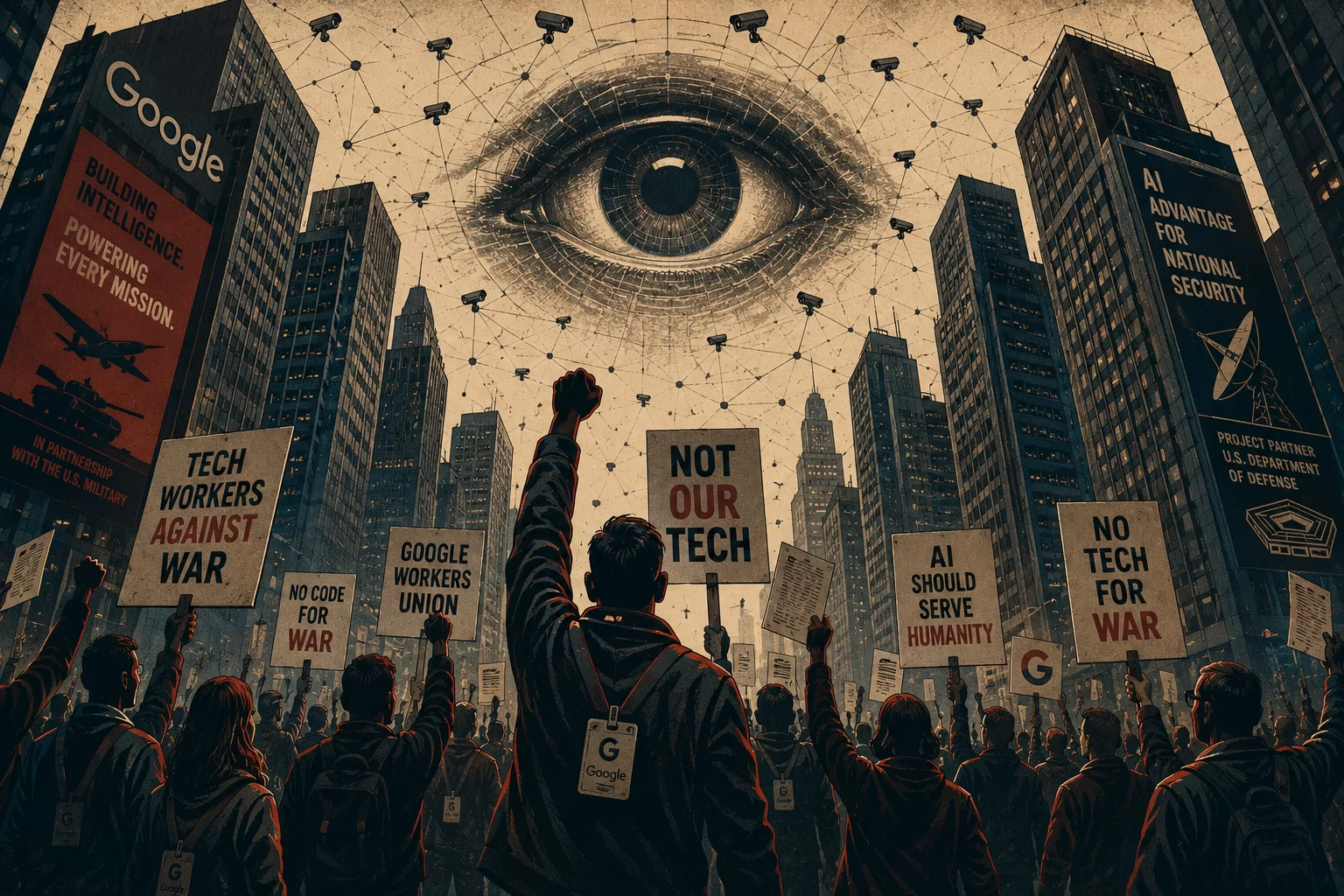
Within that narrative, demands for transparency, oversight and public scrutiny can increasingly be portrayed as barriers to progress, while the expansion of surveillance and automated decision-making becomes easier to frame as common sense rather than a political choice. A very recent example of that is Google’s workers unionizing and protesting over the company’s new deal with the Pentagon, granting the U.S. military access to Gemini AI models within classified defense networks for “any lawful purpose.”. To me, the message is clear when the employees building the technology state: “We want to see AI benefit humanity; not to see it being used in inhumane or extremely harmful ways,” the employees wrote, warning that current decisions could cause “irreparable damage” to Google’s role in the world.
This is where AI absolutism becomes more than a debate about technology, and switches to politics and governance. Once efficiency becomes the highest value, every safeguard starts to resemble a delay, every demand for transparency becomes an inconvenience and every human being asking difficult questions risks being reclassified as friction.
The beneficial contradictions
Reducing AI to a tool of surveillance would be just as misleading as reducing it to a job-destroying machine.
AI has already produced genuine scientific benefits. Systems such as AlphaFold have transformed protein structure prediction and accelerated biomedical research. Machine learning is increasingly being used in drug discovery, genomics, diagnostics and materials science. Researchers can analyse datasets at scales previously impossible and identify patterns that would have taken years to uncover through traditional methods.
Future medical treatments may emerge faster because of AI-assisted research. Scientific discoveries may become easier to identify, complex biological systems may become more understandable.
This creates an uncomfortable contradiction. The same broad family of technologies helping researchers investigate cancer treatments can also be used to monitor employees, expand surveillance capabilities and support military operations.
This is why simplistic narratives about AI being either good or bad fail. The full picture is messy, complicated and much more political.
AI as a technology itself cannot be inherently democratic or authoritarian. A technology cannot be measured on a political compass map. Its effects depend on who deploys it, why they deploy it and what incentives guide its use.
Many of these beneficial applications fall short because of the growing inequality that receives far less attention than automation. While AI tools are becoming increasingly accessible, the ability to use them effectively, identify their limitations and critically evaluate and validate their outputs is not. As argued in my previous article on AI literacy, those with the knowledge to leverage AI while recognizing its failures gain a growing advantage in education, research and professional environments, while those without that literacy risk becoming increasingly dependent on systems whose answers they cannot meaningfully evaluate and accept ad truth, without checking bias and factuality.
Deterministic doomerism
One of the greatest risks in discussions about AI is falling into a form of technological doomerism.
Here, I mean “doomerism” not just in the sense of believing doom is inevitable (which is both a false and self-fulfilling belief), but more generally, thinking about AI risks in a quasi-religious way. A growing number of AI discourse both on social media and politically, presents predictions of mass unemployment, societal collapse or superintelligent domination with a level of certainty that the available evidence simply cannot support. These arguments often borrow language from religion and science fiction alike, as if AI is an unstoppable force moving humanity toward a predetermined destination.
Technology does not emerge in isolation, instead is influenced by political decisions, economic incentives, regulatory choices, social values and what society is willing to deem acceptable. That acceptance bar lowers once people become convinced that a particular future is inevitable. With that, concentration of power becomes efficiency and extraordinary measures become easier to justify.
The future of AI technology has not been written in stone. Treating it as predetermined may ultimately be one of the most consequential mistakes we make, as the moment we accept inevitability is often the moment we stop questioning who benefits from it.