
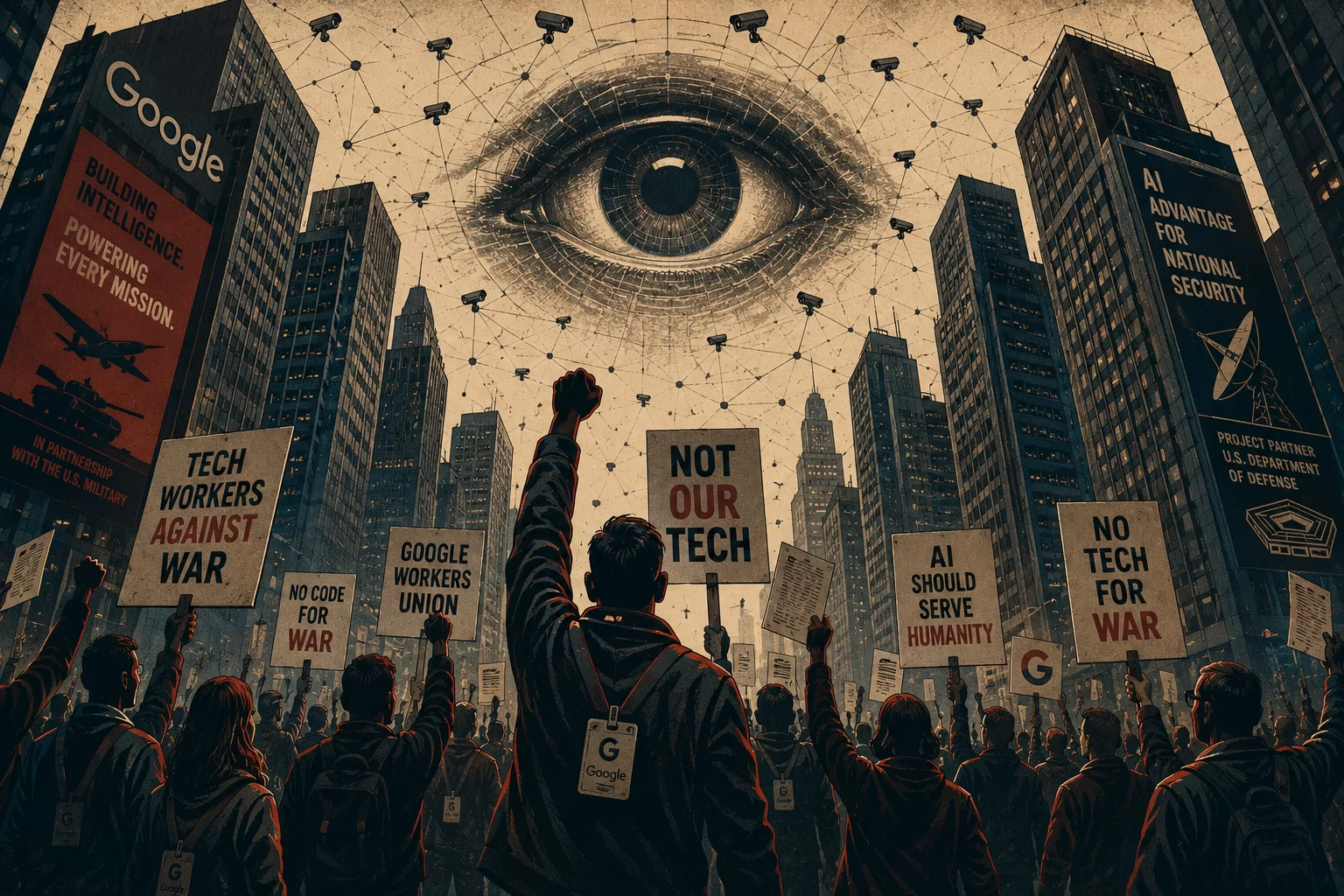
In May 2026, the Pentagon formally partnered with Google DeepMind, Google’s London-based AI laboratory, granting the U.S. military access to Gemini AI models within classified defense networks for “any lawful purpose.”
That move immediately triggered backlash and protest from employees, researchers and civil liberties advocates. As harsh as it sounds, the concern was not that another tech company signed another defense contract. That stopped being surprising years ago. The concern is what this specific partnership represents inside a rapidly consolidating AI system already deeply entangled in military, intelligence and surveillance infrastructure.
According to reporting from The Guardian, workers at DeepMind’s UK offices voted to unionize, partly driven by fears surrounding the company’s military partnerships and the broader direction of AI deployment under the Trump administration. The workers requested recognition through the Communication Workers Union and Unite the Union, potentially representing more than 1,000 employees at one of the world’s most influential frontier AI laboratories.
As per their article, one worker stated they joined the union due to concerns about “AI being used to empower authoritarianism, whether through military or surveillance applications, both foreign and domestic.” Another pointed directly to the Pentagon’s expanding AI ambitions and what they described as the administration’s “capricious Iran war” as evidence that the Department of Defense was “not a responsible partner.”
Disclaimer: This article is based entirely on publicly available information, with all sources cited and linked throughout the text. The analysis reflects the author’s interpretation of reported events, statements and documents. Some sections contain personal commentary intended to contextualize the broader implications of these developments. The article discusses sensitive topics including surveillance technologies, military applications of artificial intelligence and ongoing geopolitical conflicts, and is presented for informational and analytical purposes.
Pentagon and the umbrella of AI companies
The outcry from Google’s employees is probably a tipping point from the people building these systems and seeing their methods of use. This deal is a bead in a larger chain. Seemingly, Pentagon is becoming more and more interested into partnerships with BigTech companies. Pentagon rolled out GenAI.mil in December, a U.S. Department of Defense platform.
In GenAI.mil we can find a few AI companies. Firstly, on 9th December 2025, The Department of War announced the launch of Google Cloud’s Gemini for Government as the first of several frontier AI capabilities to be housed on GenAI.mil, as a result of Donald Trump declaring a mandate to achieve an unprecedented level of AI technological superiority in July of the same year.
“We are pushing all of our chips in on artificial intelligence as a fighting force. The Department is tapping into America’s commercial genius, and we’re embedding generative AI into our daily battle rhythm.” Secretary of War Pete Hegseth remarked, “AI tools present boundless opportunities to increase efficiency, and we are thrilled to witness AI’s future positive impact across the War Department.”
Secondly, OpenAI’s ChatGPT was included in GenAI.mil, to “enhance mission execution and readiness, delivering reliable capabilities to the joint force” as per a War Department news release. Pete Hegseth this time celebrated the deal with the statement: “The future of American warfare is here, and it’s spelled AI.”
At last, the partnership then follows a $200 million deal between xAI, Pentagon and the Department of War at the end of 2025 and deployment in early 2026, to develop an “AI arsenal” to “address critical national security challenges”. To quote the Department od War, “users will also gain access to real‑time global insights from the X platform, providing War Department personnel with a decisive information advantage.“
It’s worth of notice that this deal was happening amidst the controversies of xAI’s Grok generating non-consensual sexual imagery and undressing women, including minors. After worldwide restrictions and bans in several countries, Musk and X responded with public assurances, announcing new safeguards and restrictions on Grok. According to my further research and an investigation from Reuters, Grok still generates such content, despite the applied restrictions.
How come it doesn’t alarm you that civilian and military personnel will have a live stream propaganda from a platform known for its bias? The same AI that regulators worldwide are scrambling to contain due to its role in generating sexualized, misogynistic and racist content is being positioned as a trusted component of U.S. government infrastructure?
The Problem Is Not A Chatbot
The public framing of the Pentagon-Google DeepMind deal sounds deceptively harmless with using the tech bro banter of technological prosperity: AI integration, cloud infrastructure, API access, operational support, efficiency, decision assistance. The usual sterile corporate vocabulary used whenever institutions want to avoid saying “surveillance architecture”.
If you imagined that this deal means an AI chatbot helping military staff summarize documents or make charts, I’d love to have your naivety. The agreement allows the Pentagon to use Google’s AI for “any lawful government purpose” as per the Information. At time of writing, I am unable to find the contract, so I will provide data from news sources.
The claim “any lawful government purpose” itself creates so many loopholes for development of autonomous weapons systems and expanded surveillance, especially after Pentagon just signed deals with 8 AI companies for classified military work. These are the same claims Anthropic refused Pentagon a few months ago. We’ll dig into those deals as the article goes on.
According to the Guardian, Google said it supported government agencies across both classified and non-classified projects. Google’s agreement requires it to help in adjusting the company’s AI safety settings and filters at the government’s request, according to the Information report. The contract includes language stating, “the parties agree that the AI System is not intended for, and should not be used for, domestic mass surveillance or autonomous weapons (including target selection) without appropriate human oversight and control”.
A Google spokesperson confirmed the company’s involvement with government agencies across both classified and non-classified projects. “We believe that providing API access to our commercial models, including on Google infrastructure, with industry-standard practices and terms, represents a responsible approach to supporting national security.
However, the agreement also says Pentagon does not give Google the right to control or veto lawful government operational decision-making. I will add a personal commentary to this later, as Pentagon declined to officialy comment on the matter.
The Defense Department itself openly described the agreements as helping transform the United States military into an “AI-first fighting force” designed to maintain “decision superiority across all domains of warfare.”
If we look closer into the wording of the statement, “Decision superiority” sounds clinical, but in practice it refers to accelerating the speed at which militaries collect, process and act on information. In modern warfare, whoever processes surveillance data fastest increasingly controls the battlefield. AI becomes less of a support tool and more of a command infrastructure layer itself.
To understand why so many Google employees are protesting against this deal, we need to look at recent history as how systems like this tend to evolve. Neither this being the first time Google’s relationship with military and surveillance systems has sparked employee revolt.
First Revolts of Maven
The general idea that AI companies are only now being used for military applications is false. Google crossed this boundary years ago. In 2017, the U.S. Department of Defense launched Project Maven, an initiative designed to integrate machine learning into military intelligence workflows. Google provided AI technology capable of analyzing enormous quantities of drone footage and surveillance imagery far faster than human analysts alone could manage, accelerating military targeting and battlefield decision-making processes.
When Google’s involvement became public in 2018, thousands of employees protested internally. Workers signed petitions, resigned from the company and publicly argued against the use of AI for warfare. The backlash became severe enough that Google announced it would not renew the Maven contract in 2019 and introduced a set of ethical AI principles, including a pledge not to design AI systems for weapons or technologies whose primary purpose was causing harm.
After Google stepped away publicly, Palantir Technologies took over major parts of Maven in 2019, and the infrastructure continued evolving inside the broader military AI ecosystem. And there is a lot to say on Palantir’s ideology and doctrine, including their involvement in recent conflicts and human rights violations, such as their AI being used in the school bombing in Iran.
As explored in my previous investigation on BigTech’s involvement, Google continued expanding deeper into military cloud infrastructure, surveillance pipelines and geopolitical AI systems through projects such as Project Nimbus.
Google Worried About Human Rights violations
That relationship became even more visible in April 2021, when Israel’s Finance Ministry announced Project Nimbus, a $1.2 billion cloud computing contract between the Israeli government, Google Cloud and Amazon Web Services.
Under the agreement, Google and Amazon would provide cloud computing, artificial intelligence and machine learning services to Israeli government agencies while establishing local cloud infrastructure physically inside Israel under strict security requirements.
Publicly, Google claimed the contract focused on civilian sectors such as healthcare, transportation, finance and education and did not involve highly sensitive or classified information.
However, the Israeli military and defense apparatus were stakeholders in the agreement from the beginning. More importantly, Google and Amazon are contractually forbidden from denying service to any particular entities of the Israeli government, including its military. Also, terms Israel set for the project contractually prevent Amazon and Google from halting services due to boycott pressure from their employees. It seems that what is signed, must be done by all costs.
Although Project Nimbus’ full operational scope has not been publicly revealed, Google Cloud’s AI ecosystem already included technologies capable of facial detection, automated image categorization, object tracking and sentiment analysis. Similar systems as Nimbus had previously been used by U.S. Customs and Border Protection for border surveillance operations.
4 months before Google signed on Nimbus in 2021, officials at the company had warned that the contract will harm its reputation and enable human rights violations. In 2024, Google’s lawyers, policy team employees and outside consultants, who were asked to assess the risks of the agreement, wrote that since “sensitive customers” like Israel’s Ministry of Defense and the Israeli Security Agency were included in the contract, “Google Cloud services could be used for, or linked to, the facilitation of human rights violations, including Israeli activity in the West Bank.”
What do the employees say?
One of the most visible critics, Ariel Koren, a marketing manager for Google’s educational products, alleged she was effectively pushed out of the company after being given an ultimatum to relocate to São Paulo within 17 days or lose her position. Her case became symbolic of what many employees viewed as retaliation against dissent surrounding military-linked contracts.
The backlash intensified further after the war and genocide in Gaza escalated. Reports later indicated that Google provided the Israeli military with expanded access to AI systems and cloud infrastructure during the conflict. Activists connected to the #NoTechForApartheid movement pointed to reporting from +972 Magazine describing AI-assisted targeting systems such as “The Gospel,” “Lavender” and “Where’s Daddy,” which allegedly categorized buildings as military targets, identified Palestinians as suspected militants and tracked movements for targeting operations.
In February 2025, Google removed their pledge to abstain from using AI for potentially harmful applications, such as weapons and surveillance, according to the company’s updated “AI Principles.” In web archives, I found that the prior version of the “AI principles” said clearly Google would not use its AI technology for weapons or surveillance.
In April 2025, around 30 Google employees were reportedly fired following protests against Project Nimbus and the company’s broader military-related contracts. Google claimed the firings were related to “disruptive activity” rather than retaliation.
Then came the Pentagon’s newest AI partnerships and the reason this article started – Google’s DeepMind deal with the US Pentagon from May 2025. At least 600 Google employees signed an open letter to CEO Sundar Pichai demanding the company refuse classified military AI deployments and urging to reject classified AI work with Pentagon. I will cite some of the employee statements:
“We want to see AI benefit humanity; not to see it being used in inhumane or extremely harmful ways,” the employees wrote, warning that current decisions could cause “irreparable damage” to Google’s role in the world.
At the same time, DeepMind employees in the UK voted to unionize partly in response to Google’s expanding military partnerships and the Pentagon deal itself. Workers reportedly discussed possible “research strikes,” where employees intentionally avoid contributing meaningful improvements to systems like Gemini while still technically remaining productive enough to avoid retaliation. Others demanded an independent ethics oversight body and the right to refuse participation in projects on moral grounds.
“As people working on AI, we know that these systems can centralize power and that they do make mistakes.”
That may be the single most honest sentence in this entire debate.
is there a way out for BigTech?
On 1st May 2025, the Pentagon confirmed it had reached agreements with seven leading AI companies, Google among them. Others included SpaceX, OpenAI, Nvidia, Reflection, Microsoft and Amazon Web Services. Anthropic was notably absent from the group. Not every AI company has embraced this military transition equally publicly.
Earlier this year, Anthropic publicly refused a Pentagon request to remove safeguards from its AI models, citing ethical concerns tied to “mass domestic surveillance” and “fully autonomous weapons.” After the refusal, President Donald Trump subsequently ordered federal agencies to stop using Anthropic technology within 6 months, intensifying the confrontation over military AI governance. Anthropic then filed two federal lawsuits on 9th February 2025, challenging the Trump administration’s decision to label the company a national security “supply chain risk” and cut off use of its technology across the federal government.
Then, OpenAI stepped into the gap, moving forward with a reported $200 million defense contract allowing deployment of its AI models on classified “Department of War” networks. CEO Sam Altman publicly defended the deal, stating that OpenAI’s mission required balancing safety with cooperation with democratic governments. He emphasized contractual principles prohibiting domestic mass surveillance and maintaining human responsibility over use of force.
The pattern now repeats across the industry like a broken record:
AI Arms Race
Once AI systems like these exist at scale, their applications inevitably expand beyond their original justification. Surveillance introduced for counterterrorism migrates into immigration enforcement. Commercial location data becomes law enforcement intelligence. Predictive policing expands into political monitoring. Civilian cloud systems become military infrastructure.
Investors themselves are now beginning to raise alarms. A coalition of shareholders holding roughly $2.2 billion in Alphabet shares (Alphabet being a parent company of Google) recently wrote a public letter, demanding greater transparency regarding Google Cloud and AI deployments in “high-risk” environments, specifically citing immigration enforcement, Project Nimbus and concerns about the company’s internal oversight mechanisms.
The modern AI race is about who controls the architecture capable of processing the data our civilization makes by itself. Unlike older industrial systems, AI infrastructure scales extraordinarily fast once integrated into government systems. A model trained for battlefield intelligence today can influence border enforcement tomorrow and domestic monitoring the year after that.
The uncomfortable reality is that many of these systems are not being built secretly in underground facilities by shadow organizations. There’s no black-ops conspiracy theory here. These systems are being developed openly by some of the world’s most admired technology companies, in the most influential countries, often under the language of innovation, efficiency and national security.
People imagine authoritarian systems arriving dramatically. In reality, they will arrive through APIs, procurement contracts, cloud integrations, polished corporate language about “human-centered AI”, while scattering responsibilities for their own consequences. Most importantly, they will rise from our silence and lack of understanding.
Then years later everyone acts confused about how the surveillance architecture became impossible to escape. Civilization keeps sleepwalking into infrastructure decisions because the interface looks friendly or acceptable enough. A smiling AI assistant apparently feels less threatening than the phrase “centralized predictive behavioral analysis framework.” Humans are remarkably easy to pacify with rounded UI corners and pastel branding.