
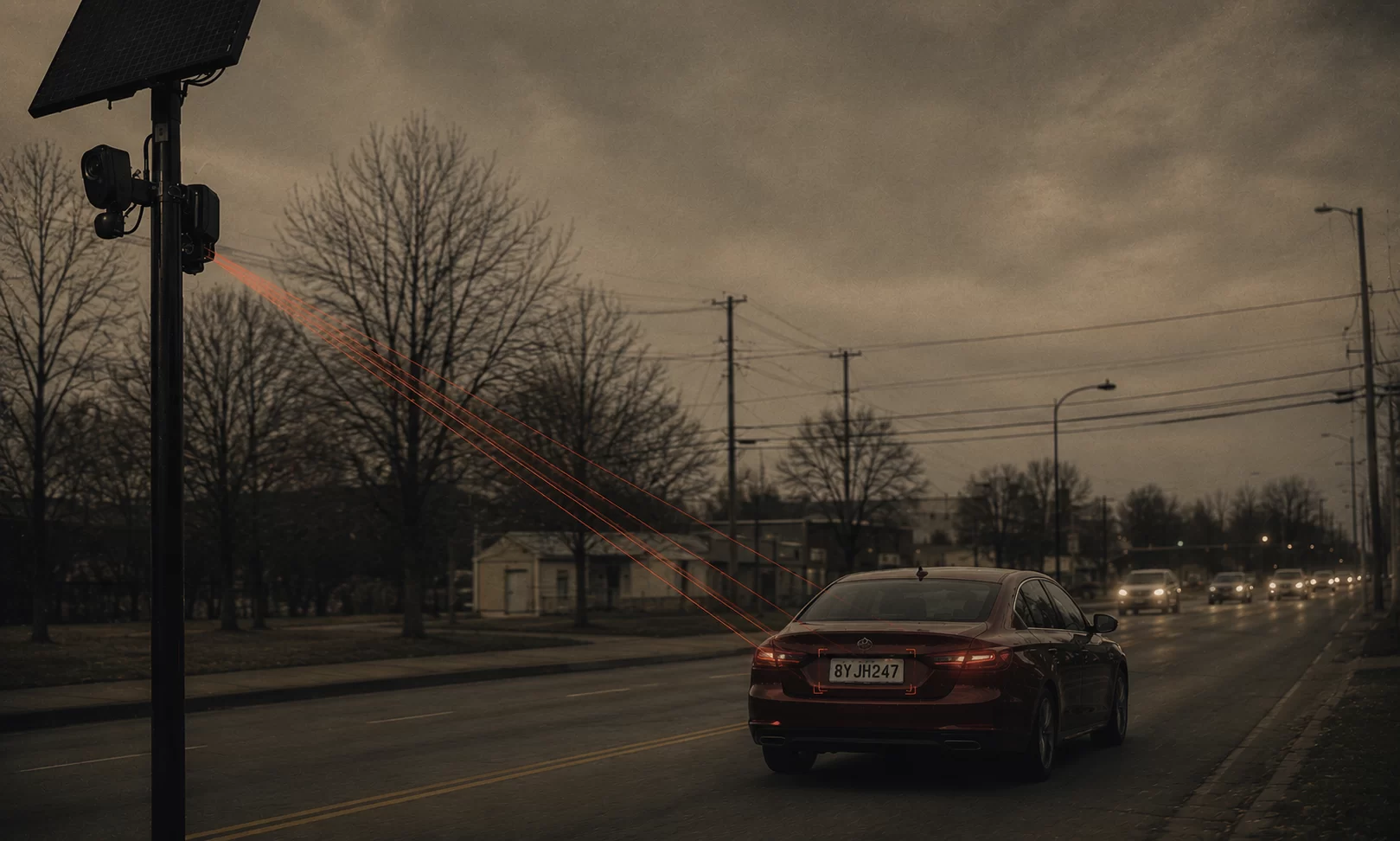
Flock Safety markets itself as a public safety company. Their surveillance cameras promise to recover stolen vehicles, identify suspects and help solve crime. My intention was to investigate the risks and misuse of another AI surveillance system. That changed when I discovered a patent owned by Flock’s founders describing technology capable of recognising and monitoring far more than licence plates. That discovery changed the investigation entirely and the question became: what exactly is Flock building? To answer that, we need to start at the beginning.
Disclaimer: This investigation is based exclusively on publicly available information available at the time of publication, including company statements, patents, court documents, police reports, government records, media reporting, academic sources and publicly accessible databases. Every reasonable effort has been made to accurately represent the cited material. Sources are provided throughout to allow readers to independently verify the information and review the original context. Any analysis, interpretation, commentary or opinion is explicitly identified as the author’s own and should not be interpreted as a statement of fact beyond the cited evidence. Readers are encouraged to consult the original sources and draw their own conclusions.
What the Cameras Do?
Flock Safety cameras are automated license plate readers equipped with artificial intelligence. They photograph passing vehicles, extract plate numbers and vehicle characteristics, and upload the resulting information into a searchable system used by law enforcement and other government agencies.
At least 90,000 Flock cameras are reportedly operating across 6,000 communities in the USA, reading more than 20 billion license plates every month. Each camera may appear local, attached to one road, neighbourhood or parking area, but the information is not confined to the place where it was collected. It enters a shared database that can be searched across jurisdictions.
That means a car passing through one community can become visible to officers elsewhere. A routine trip can be logged, retrieved and placed into an investigative timeline long after the driver has moved on. The system does not only identify vehicles associated with active alerts. It also continuously records ordinary traffic and preserves it for later searching. The system is marketed as a way to locate stolen vehicles, identify suspects, investigate crime and produce leads quickly. Its usefulness depends on the accuracy of automated recognition and the judgment of the people acting on its results.
The practical result is a large database of movement built from people who, in most cases, are not suspected of any offence.
Personally, it failed in all of this uses. After the examples of use in real life, I find hard to believe that Flock is there for the benefit of public service and safety.
Who is behind Flock Inc.?
Flock Group Inc. was founded in 2017 by Garrett Langley, Matt Feury and Paige. It began as a side project in which the three co-founders built their first video surveillance cameras by hand around Langley’s dining room table. The company is not publicly traded, meaning ownership is divided between founders, employees and venture-capital investors. The exact ownership percentages are not public. Flock Safety (Flock Group Inc.) is a public safety technology company that builds hardware and software for automated license plate recognition (ALPR), video surveillance, gunfire detection and drone systems to help law enforcement, neighborhoods, businesses and schools eliminate crime through evidence collection.
ALPRs, are defined, as per Flock’s webpage as “a camera system that captures license plates and uses AI-powered software to convert them into searchable data, including vehicle make, model, color, location, and time. Law enforcement, businesses, and communities use ALPR systems to identify vehicles, develop leads, and respond faster to incidents.”
Who are the Major Investors?
Flock serves police departments, HOAs and private entities, solving investigative gaps by providing objective evidence that boosts crime solve rates, claiming contributions to 5% of U.S. reported crimes, all while emphasizing privacy features like community-owned data and automatic deletions. With $38 million raised at a $3.5 billion valuation in 2022, rapid growth (No. 7 on Deloitte Tech Fast 500 in 2022), and 900+ employees by 2024, Flock shows strong momentum through expansions like AI-powered video searches and drone acquisitions. By 2025, it had deployed nearly 90,000 cameras across 7,000 networks, driven by over $2 million in contracts in states like Massachusetts alone. According to Reuters, in the same year the company reached a valuation of $7.5 billion, with a $275 million funding led by Andreesen Horowitz, for the purposes of expanding drone products and manufacturing facilities.
That is the same Andreesen Horowitz who in his 5,200 word “techno-optimist manifesto,”, writes ideas like: AI is good, fascists are saints and anyone who stops rich people like him from funding, deploying, and doing whatever they want with tech is a literal murderer. To me, it sounds like the ramblings of a college student who just finished his first reading of Ayn Rand. Why do AI capitalists love publishing techno-libertarian manifestos? Just recently, I wrote about Palantir’s technofascism manifesto and explained it in detail, point by point, trying to make it as understandable to everyone, without the hyperbolic philosophical rhetoric.
Flock’s initial venture capital came largely from members of the so-called “PayPal Mafia”: Former PayPal CEO Peter Thiel’s Founder’s Fund and several other Thiel-associated firms, including Bedrock Capital, Y-Combinator and Initialized Capital.
No article today can avoid Peter Thiel and Palantir these days. Founders Fund, a venture capital firm Thiel started in 2005, did invest in Flock’s latest $275 million “fundraising round” in 2025. Flock has not shared individual investment amounts publicly.
Thiel’s broader philosophy, Palantir’s role in military operations, intelligence work and surveillance infrastructure, as well as the company’s involvement in recent military conflicts, are subjects I have examined extensively in previous investigations. Rather than repeating that analysis here, it is enough to recognise that Flock does not operate in isolation. Its technology, funding and strategic direction are part of a much broader surveillance ecosystem.
How Flock cameras work?
The basic idea behind Flock is addressing evidence shortages in crime investigations by leveraging vehicle data as a persistent identifier. The company quickly gained traction through contracts with law enforcement and communities, scaling from initial ALPR deployments to nationwide adoption.
Its core products, like the Falcon and Sparrow cameras, use computer vision and machine learning to scan vehicles, log data in a searchable cloud database and alert officers to matches against crime watchlists.
If we shortly sum up how Flock cameras work, consider them as cameras that monitor traffic and photograph the rear of all passing vehicles. Their software uses computer vision to read the vehicles’ license plates and identify other distinguishing visual characteristics, sending that information to a central server via cellular network.
Flock’s servers then log the identifying data, with the time and location of the scan in a searchable database and compare all results with the National Crime Information Center, as well as state and local police watchlists of cars that are reported stolen or otherwise of interest to the police, instantly alerting nearby officers upon a match.
There is a difference between ALPRs like Flock’s cameras and speed cameras/traffic enforcement cameras, as the latter pose grounds for traffic fines or finding offences. ALPRs are supposedly not for surveillance and criminal investigations, and do not perform any enforcement of traffic laws. According to Jill Walker Rettberg’s 2023 publication “Machine Vision: How Algorithms are Changing the Way We See the World”, the cameras are also designed to not be noticed in the urban environment.
Flock claims that its system’s ability to identify vehicles’ visual features, which it calls “vehicle fingerprint technology”, is unique among ALPR systems; they state that the system can identify vehicles’ make, model and color, as well as other distinguishing attributes such as mismatching colors, bumper stickers, dents, and temporary license plates, allowing investigators to search for recorded vehicles based on these characteristics. If you paid attention to the ALPR definition a little above, it seems like I copy pasted a bunch of similar text to explain the Vehicle Fingerprint Technology. I also find those words repeating all across Flock product descriptions and they kind of lack clarity of the operational use of the tech.
Patent and Ownership
Upon deeper searching for “Vehicle Fingerprint Technology”, at time of writing, there were very little traces of how this tech is different and how it works. However, I found a patent filed in 2020 by Flock (US11416545B1), with cited inventors being both founders Garrett Langley and Matt Feury, named “System and method for object based query of video content captured by a dynamic surveillance network” (yes, you can read patents in PDF). The word “fingerprint” in the patent description “refers to any one or more features or measurable properties associated with an identified object such as, but not limited to, an automobile or animal. The features that define an object’s fingerprint may be either numeric or structural in nature. As a way of example, and not limitation, features that may be used to define an object fingerprint include, but are not limited to, Hough lines, object height, object width, black/white pixel ratio, non-zero pixel ratio, white balance, hash value, etc.”
After reading the patent description, I doubt this is just concerning cars, despite the company’s efforts to present them as safety software to the public. Why? Flock cameras are being installed amidst an AI arms race, where governments are signing multibillion-dollar agreements with AI and Big Tech companies in the name of security, defense and public safety. In recent years alone, the Pentagon has expanded military AI partnerships with companies including Google, OpenAI, Microsoft, Amazon Web Services, Nvidia, SpaceX, Reflection AI and xAI, with OpenAI and xAI each receiving $200 million defense contracts, as we have previously explored.
Across all these agreements, the same concerns overlap: mass surveillance, the collection and military use of civilian data, AI-assisted targeting, documented links to military operations in supporting the genocide in Gaza, with a never-ending chain of scattering blame and making responsibility difficult to assign.
I am NOT claiming that Flock is using the surveillance methods described in the patent for the already installed cameras. My question is: since the Flock founders own the technological capability and the legal precedent to use such technology; who is monitoring them, or stopping them from implementing that technology? Will it take just one government agreement and a few billions, under the name of “safety and security”? Feel free to read the patent and decide for yourself.
Flock and their Privacy Flock-ups
Privacy concerns surrounding automated licence plate readers (ALPRs), including Flock Safety’s system, extend well beyond the collection of vehicle registrations. Civil liberties organisations including the American Civil Liberties Union (ACLU) and the Electronic Frontier Foundation (EFF) argue that these systems create detailed records of ordinary people’s movements without requiring any suspicion of wrongdoing.
In a 2026 report, the ACLU criticised Flock’s business model, later acknowledging that licence plate readers may have legitimate investigative uses if accompanied by strict safeguards. However, it argued that such systems should not create comprehensive records of everyone’s movements, stating that government surveillance should require individualized suspicion rather than continuous monitoring of the general public.
Throughout 2025, EFF conducted investigations into Flock Safety’s ALPR network. They found Agencies logging hundreds of searches related to political demonstrations, such as the 50501 protests in February, Hands Off protests in April, and No Kings protests in June and October. Three agencies used Flock’s system to target activists from Direct Action Everywhere, an animal-rights organization using civil disobedience to expose factory farm conditions.
In November 2025, EFF found that more than 80 law enforcement agencies used language perpetuating harmful stereotypes against Romani people when searching the nationwide Flock Safety ALPR network. Between June 2024 and October 2025, police performed hundreds of searches using terms such as “roma” and racial slurs, often without mentioning any suspected crime. Audit logs revealed searches including “roma traveler,” “possible g*psy,” and “g*psy ruse.” Grand Prairie Police Department in Texas searched for the slur six times while using Flock’s “Convoy” feature, which identifies vehicles traveling together, essentially targeting an entire traveling community without specifying any crime.
In a list of several US states, we have a few more reality checks:
In Ohio, a Flock camera reportedly misread a single character on a licence plate, interpreting a 7 as a 2. The incorrect result matched a stolen vehicle, leading officers to stop the driver, deploy police dogs and arrest him before authorities determined that the camera had simply misread the plate. Police however, treated that result as sufficiently reliable to escalate the encounter and literally release the dogs.
In Colorado, police relied on repeated Flock hits to accuse a woman of a $25 package theft, and the officer refused to show her the footage of the alleged theft. She spent days collecting evidence from apps and produced a dashcam footage showing she was elsewhere at the time of the alleged theft. No charges were filed, and no civil suit was filed at the time of publication of this post.
In Arkansas, residents discovered that a Flock camera had been positioned directly toward their home, allowing continuous recording of their vehicles, visitors and daily routines. After the Institute for Justice intervened and cited 4th Amendment privacy violations, the city removed the surveillance camera.
The most concerning flock-up also comes from Arkansas. Police said they stopped a family because they believed the SUV was stolen, being alerted by Flock’s ALPR, which misread the plate. The father inside was ordered to go out from the vehicle at gunpoint in front of his girlfriend and child. Police first blamed a surveillance camera glitch. The full report shows the officer also blamed the plate border. To add, that report says that the plate had to be visually confirmed by the policeman firstly, however, he also misread.
Safety Concerns
Questions have also been raised about the security of the software infrastructure itself. A Youtuber named Benn Jordan reported identifying 51 vulnerabilities affecting Flock systems. According to his testing and Privacy Guides, some cameras could allegedly be compromised in under 30 seconds, allowing an attacker to convert law-enforcement infrastructure into a privately controlled surveillance device. He further reported that some cameras operated on an Android 8, version discontinued in 2021, with no security updates since that year and is missing all of the Android security features added since 2017. Flock reportedly lacked two-factor authentication until the absence of that protection became public. The cameras also have hard-coded Wi-Fi network names that they will happily connect to when an LTE signal isn’t available, making it easy for an attacker to trick them into connecting to a malicious Wi-Fi access point. Some would even connect to the malicious Wi-Fi whether a SIM card was inserted or not.
These concerns became more concrete in December 2025, when 404 Media reported that at least 60 Condor cameras had been left exposed directly to the public internet. According to the report, anyone could allegedly watch live feeds, download up to 30 days of archived video, modify settings, view diagnostic logs and access system information.
The value of these systems to law enforcement is precisely what makes them valuable to malicious actors too. A camera that can be repurposed into a personal surveillance device does not stop being surveillance infrastructure when controlled by the wrong person.
Misuse, Abuse and Accountability
An ongoing review of media reports and public records by the Institute for Justice has identified at least 26 cases nationwide of officers allegedly abusing Flock and ALPR data to keep tabs on their romantic interests, including current partners, exes and even stalking strangers who unwittingly caught their eye in public.
As a reminder, these incidents did not require hacking or stolen credentials. Officers used legitimate access to perform personal surveillance by reconstructing people’s movements through licence plate searches. For your convenience and more clarity, to show you a pattern of how easy this misuse has happened over the years, I have organised the known cases in chronological order of all known ALPR romantic stalking cases I could find at time of writing and I am sure this list will be longer by the end of this year. Sources are linked into the left column:
| Location (Town, State, Year) | Occurrence |
|---|---|
| Westmoreland County, Pennsylvania (2021) | Officer Michael McSherry pleaded guilty to stalking after using ALPR readers to track his estranged wife and other family members. |
| Fort Bend County, Texas (2022) | A sheriff’s lieutenant used Flock cameras dozens of times to monitor multiple people, including someone involved in a contentious familial relationship. Suspended for two days. |
| Kechi, Kansas (2023) | Lieutenant Victor Heiar pleaded guilty to computer crime and stalking after using Flock cameras to track his estranged wife |
| Sedgwick, Kansas (2023) | Police Chief Lee Nygaard resigned after using Flock cameras more than 200 times to track his ex-girlfriend and her new boyfriend over several months. |
| Costa Mesa, California (2023) | Officer Robert Josett used Flock to track his mistress and her other romantic interests. Pleaded guilty to multiple criminal charges in April 2026. |
| Riverside County, California (2024) | Deputy Alexander Vanny used Flock to track a friend of his ex-fiancée after kidnapping charges. Convicted on multiple charges in December 2025. |
| Orange City, Florida (2024) | Officer Jarmarus Brown used ALPRs to stalk his girlfriend and her family members more than 100 times over seven months. Arrested and charged in 2025. |
| Shelby County, Tennessee (2024) | Deputy Thadius Gordon was relieved of duty after allegedly using an ALPR database to track his ex-wife’s location more than 100 times. |
| Matteson, Illinois (2024) | Internal documents showed Officer Jaila Cole-Clark conducted hundreds of Flock searches on a former domestic partner and the partner’s new partner. Resigned during the investigation. |
| Louisville, Kentucky (2025) | Officer Roberto Cedeno was charged with multiple felonies after allegedly tracking an ex-partner and her friends hundreds of times over two months using the city’s ALPR systems. |
| Milwaukee, Wisconsin (2025) | Officer Josue Ayala used Flock nearly 180 times over two months to monitor a woman he was dating and her ex-partner. Resigned in 2026 after misconduct charges. |
| Jerome County, Idaho (2025) | Sheriff George Oppedyk searched for his wife’s vehicle hundreds of times using Flock. The Attorney General found no crime, Oppedyk retired in 2026. |
| Kenosha County, Wisconsin (2025) | Deputy Frank McGrath resigned with severance after investigators found he used Flock to monitor another deputy with whom he had a romantic relationship. |
| Menasha, Wisconsin (2025) | Officer Cristian Morales was placed on leave and charged with misconduct after using Flock to track his ex-girlfriend. |
| Braselton, Georgia (2025) | Police Chief Michael Steffman was arrested after allegedly using license plate readers to stalk and harass multiple people, including a former romantic partner. |
| Bonner Springs, Kansas (2025) | Detective Kyle Rector allegedly used license plate readers to track his estranged wife and two men he believed were her new partners. Charged with multiple crimes in 2026. |
| Monroe County, Florida (2026) | Deputy Lamar Roman allegedly used an ALPR system to track and later stop a woman he met while working security on a television set. Arrested for unauthorized computer access. |
| Coffee County, Georgia (2026) | Former Deputy Chris Rozar was charged with multiple offences after allegedly using Flock to stalk a woman he was romantically interested in. Fired at the start of the investigation. |
| Niceville, Florida (2026) | Former Officer Coty Hall pleaded no contest after using Flock to track another officer and that officer’s spouse. Misconduct was uncovered through an internal audit; Hall was fired. |
| Winnebago County, Illinois (2026) | Former Deputy Tyler Bryan was charged with stalking and official misconduct after allegedly monitoring an ex-girlfriend and her new partner using ALPR data. |
| Prairie Grove, Illinois (2026) | Officer William C. Copp was arrested after searching Flock for several former romantic partners and some of their new partners. Fired from one department; second position under review. |
| Gwinnett County, Georgia (2026) | Officer Renee Downer was arrested and relieved of duty after allegedly using law enforcement databases, including an ALPR system, to monitor an ex-romantic partner. |
| Pasadena, Texas (2026) | Sergeant Michael Palitz resigned while under investigation for allegedly using Flock cameras to track and stalk a female officer. |
| Greer, South Carolina (2026) | Former Corporal Kareem Lynch was fired after an internal audit found he allegedly used Flock to monitor the movements of a subordinate with whom he had a previous relationship. |
| Richmond County, Georgia (2026) | Former Deputy Jaquarius Yarbrough was arrested after allegedly searching for the license plate of a woman with whom he had an affair 1,639 times over several months. |
| Sumter County, Florida, (2026) | County detective Brandy Almany was fired and criminally charged after using Flock and other police databases to track her husband’s ex-wife. |
| Conyers, Georgia, (2026) | Paige Forte, a supervisor in the PD’s Real-Time Crime Center, was fired and charged after using the Flock system to monitor her domestic partner’s location. |
Now you might ask, there must be a trace from the machine and an way to find these officers? In practice, audit logs are frequently presented as safeguards. Their effectiveness, however, depends entirely on whether searches are reviewed, suspicious activity is investigated and misuse produces consequences. The repeated discovery of officers tracking romantic partners suggests that existing controls often documented abuse only after it occurred rather than preventing it. After all of this, the general public is being actively convinced that these kind of cameras are for our safety and catching criminals more efficiently, while the reality shows great misuse from the law enforcement meant to protect the public.
Challenging Flock
Colorado activist Will Freeman created DeFlock, a crowdsourced map documenting Flock camera locations. Flock’s CEO described the project as “terroristic,” and the company later issued a cease-and-desist letter. As Flock faces an increasingly vitriolic backlash, they publicly regret that label and apologise.
Legal challenges have continued to expand in several US states. In October 2024, the Institute for Justice filed a federal lawsuit against the Norfolk Police Department, arguing that Flock’s ALPR program constitutes unconstitutional surveillance under the 4th Amendment. On 27th January 2026, a federal judge ruled in favour of the city of Norfolk, concluding the automated cameras are compliant with the Constitution.
Despite California law prohibiting licence plate reader data from being shared with federal agencies, reporting in 2025 found California police illegally sharing license plate data with ICE and Border Patrol.
During this period, CEO Garrett Langley publicly stated that Flock had no contractual relationship with federal agencies. The claim was later contradicted when the company acknowledged previously undisclosed pilot programs with Customs and Border Protection and Homeland Security Investigations, and admitted that its earlier public statements had been inaccurate.
Following growing public criticism, several governments reconsidered their relationship with the company. In June 2026, Cleveland’s City Council Public Safety Committee voted against renewing the city’s Flock contract. Although the agreement expired on 29 June, police continued operating the cameras while the proposal underwent further council review. The decision drew criticism from civil liberties advocates, including the ACLU of Ohio, which argued that the city was continuing a system of mass surveillance despite the expired contract.
On 10 July 2026, the Los Angeles Police Department announced it would suspend its use of Flock Safety by allowing its contract to expire, citing civil liberties concerns and the need for stronger contractual protections. Flock disputed the decision, attributing it to what it described as public misconceptions.
Resistance or Vandalism?
Public frustration is taking a physical form. Every US news outlet speaks about people destroying the cameras overnight, involving anti-surveillance messages left at the scene, even sharing those videos on social media. There is a whole niche on forums about penalties and manuals of destruction. For legal purposes, I cannot show any of those materials, as it is considered vandalism. The people damaging the cameras have been described as vandals, protesters and, depending on who is speaking, patriots.
And Flock Safety flocked again. In July 2026, Flock announced that, under its Camera Protection Plan, it would repair or replace vandalised cameras at no additional cost to its customers. In doing so, the company shifted the financial burden of vandalism away from police departments and municipalities and onto itself. That decision changes the incentive structure. For those who view Flock’s cameras as symbols of surveillance overreach, destroying a camera no longer primarily imposes a cost on the public agency or local municipality that purchased it. Instead, it directly imposes a cost on the company operating the surveillance network aka Flock Safety.
Throughout this investigation, I found court cases, security vulnerabilities, documented misuse, officers abusing legitimate access, public agencies sharing data beyond what many communities understood and growing resistance from civil liberties organisations. I also found a company that continues to expand, raise capital and sign new contracts, while owning a patent that can potentially identify and monitor any target based on its attributes.
When residents object, they are often told the cameras are staying. When civil liberties groups sue, the process takes years. When journalists investigate, the network continues expanding. When local governments attempt to reconsider their contracts, the cameras frequently remain in place while negotiations continue.
Against that backdrop, it becomes easier to understand why some people have shifted from petitions and public meetings to direct action. I do not support vandalism. But I do understand the question it raises.
If people are never meaningfully asked whether they want to live inside an expanding surveillance network, and every institutional avenue fails to alter its course, what mechanism remains for the public to exercise democratic control over the technologies watching them without consent?