
When Disney and Universal filed their lawsuit against MidJourney earlier this year, I wrote that the case marked a dangerous precedent. I argued that the real battle was no longer about protecting specific characters, but corporations taking a shift from protecting specific intellectual property toward claiming ownership over entire aesthetic languages. I warned that such litigation would embolden rights-holders to treat vague stylistic similarities as copyright infringement and that independent creators would pay the price.
Today, I find myself on the receiving end of precisely the dynamic I cautioned against.
The Takedown – Copyright Infringement
To bring some background to the whole story: Redbubble is a platform designed to help independent artists sell their work as merchandise (like shirts, stickers, mugs, prints…) without needing to run a full-scale store or production line themselves. It’s meant to lower the barrier for creatives who simply want their designs out there. I have been using this platform for several years now, selling T-shirts, stickers, mugs, basically having it as a passive income from simple designs.
If you’re a regular reader, you might ask, how did you keep to Community Guidelines since your art covers some darker topics? Easily, as none of that art was ever uploaded. There’s no point jeopardizing income on a platform not suited for that.
In short: I’ve always respected Redbubble’s standards, and they’ve always been a safe, predictable place for my work. Until…
With my Friday’s afternoon coffee, I get an email from Redbubble, with an infringement claim. Redbubble removed one of my artworks after Crunchyroll claimed it infringed on their Chainsaw Man intellectual property.
Here is the message I received:
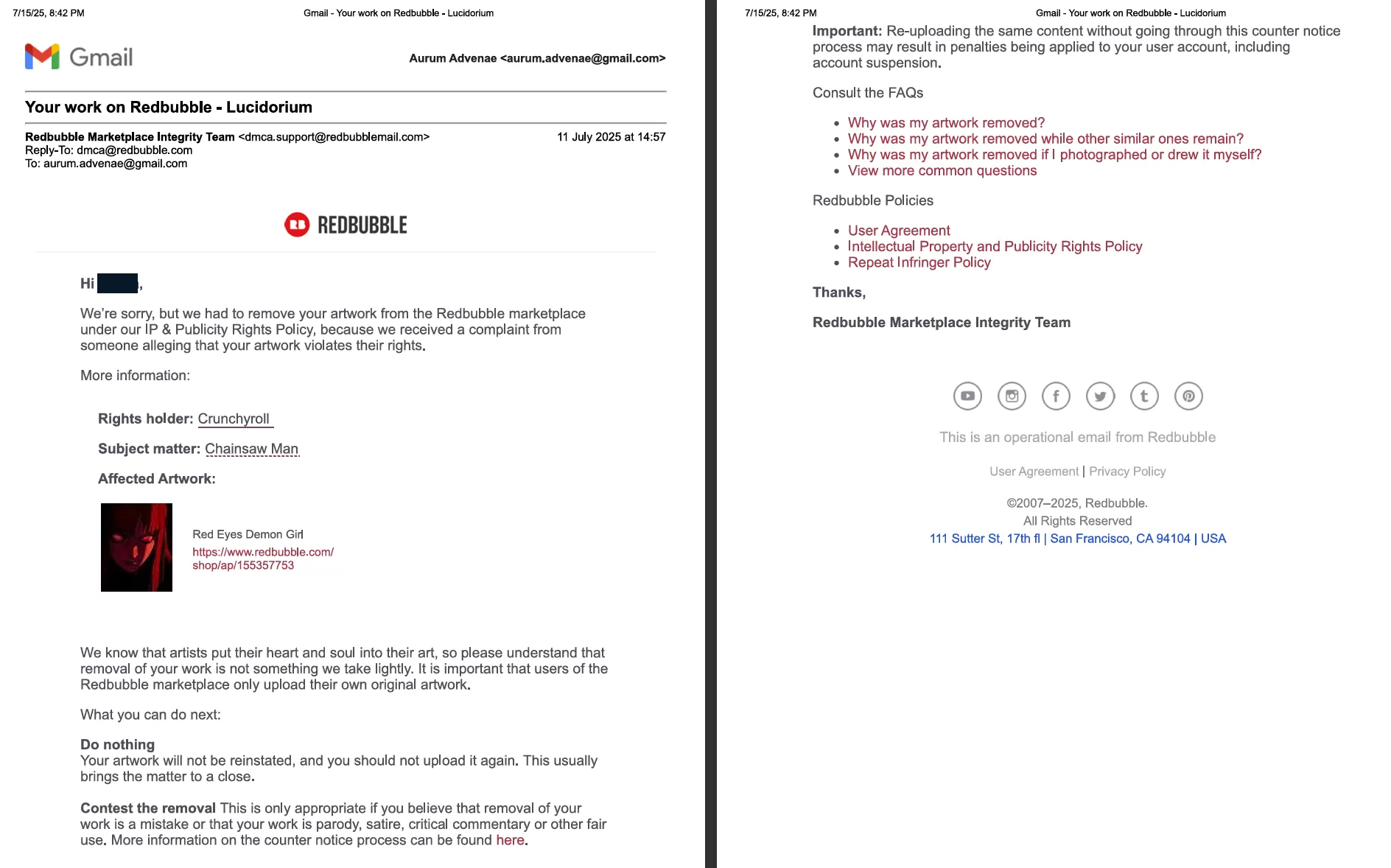
Now, I will use this platform for full transparency: At the time, I had never even heard of Chainsaw Man. I knew Crunchyroll was an anime streaming service, that’s about it. The only anime I have watched in my life is Death Note and Neon Genesis. So, I send the image to an anime-lover friend, asking which character in the anime Chainsaw Man might my image be similar to. We came down to the answer of character Makima.
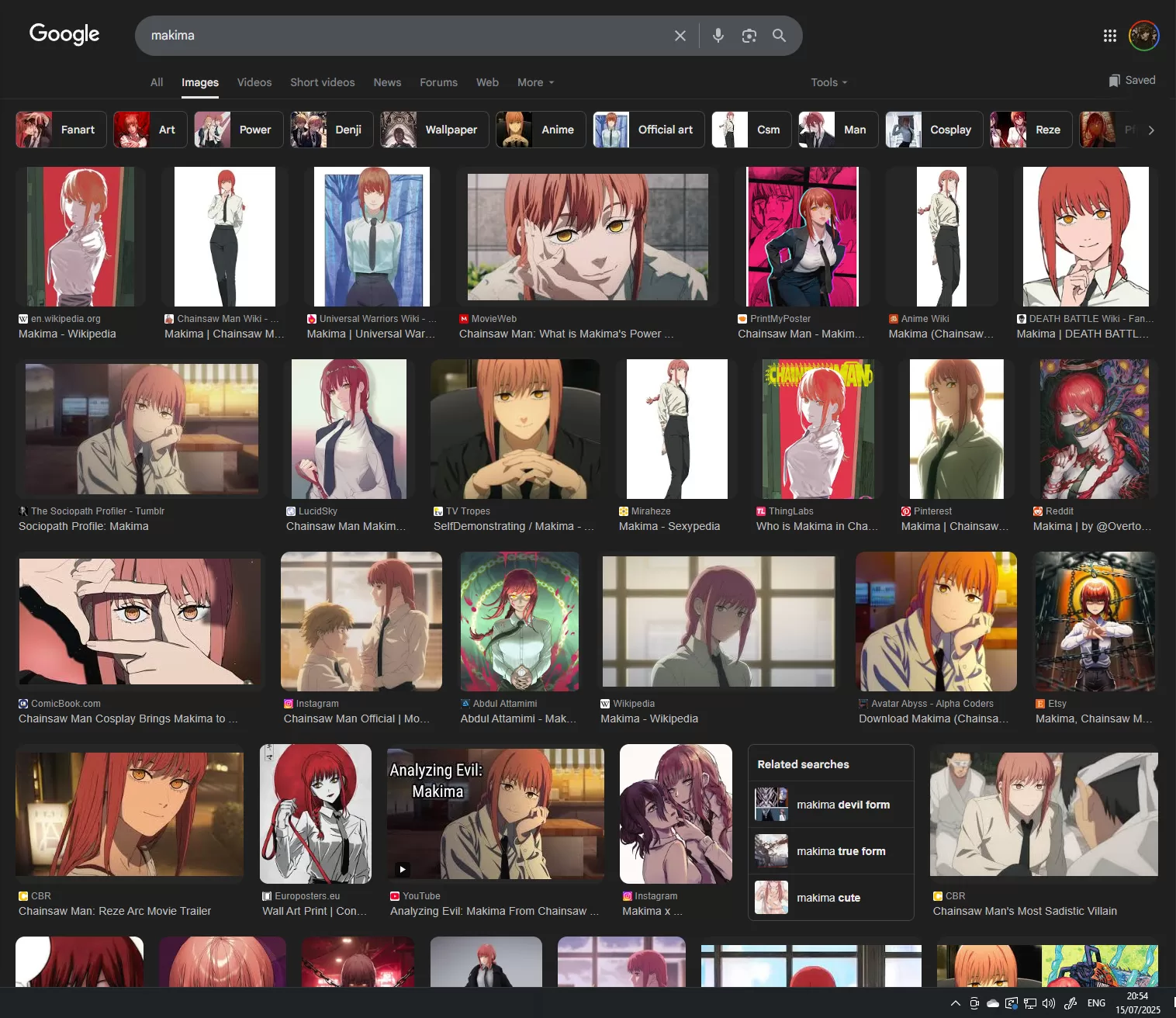
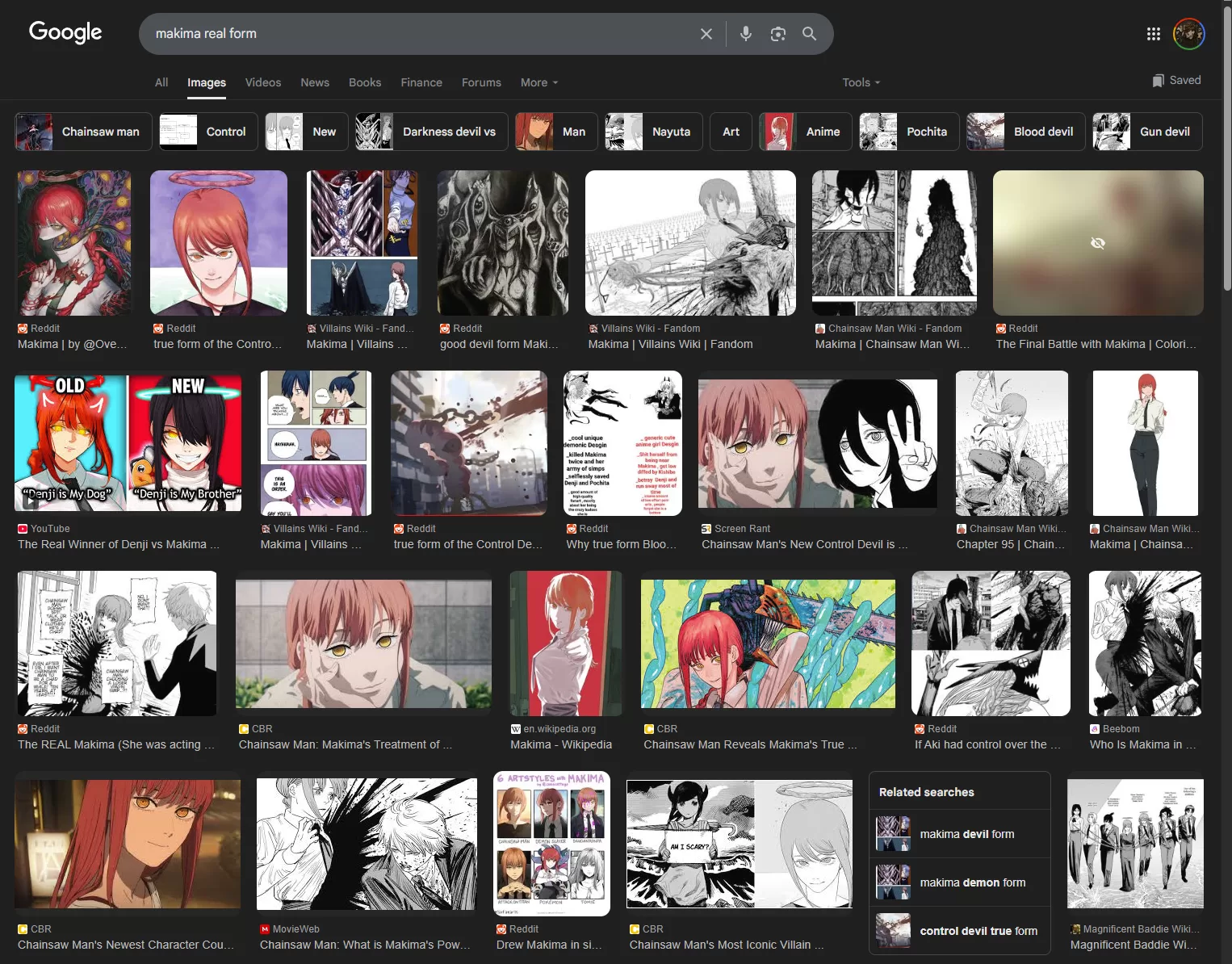
I open Google Images, and the first few images are of this red-haired girl with yellow eyes, in a white-shirt and black pants dress-up combo. Okay, I see it has some devil transformation, which is supposed to be some undepictable monster, but nothing connected to my image, as shown in both Google Searches below from my screenshot.
And here comes the funniest part to me. I dye my hair in a very similar color, wear simple and plain colors, and this was the era of AI generation in which I tried to Niji-fy myself as much as possible. Niji 5 was released and of course there was a hype. Take it as the trend predecessor of the Ghiblify ChatGPT trend. The artwork was created nearly 2 years ago, on 11th November 2023, using Midjourney and the –niji 5 model. I use MidJourney and their services and have been a regular member almost since the start.
So what Crunchyroll claims is intellectual property, was my boredom and AI-generated, stylized self-portrait, based on my own likeness, written entirely by me with the following prompt and a direct screenshot of how this image was made:
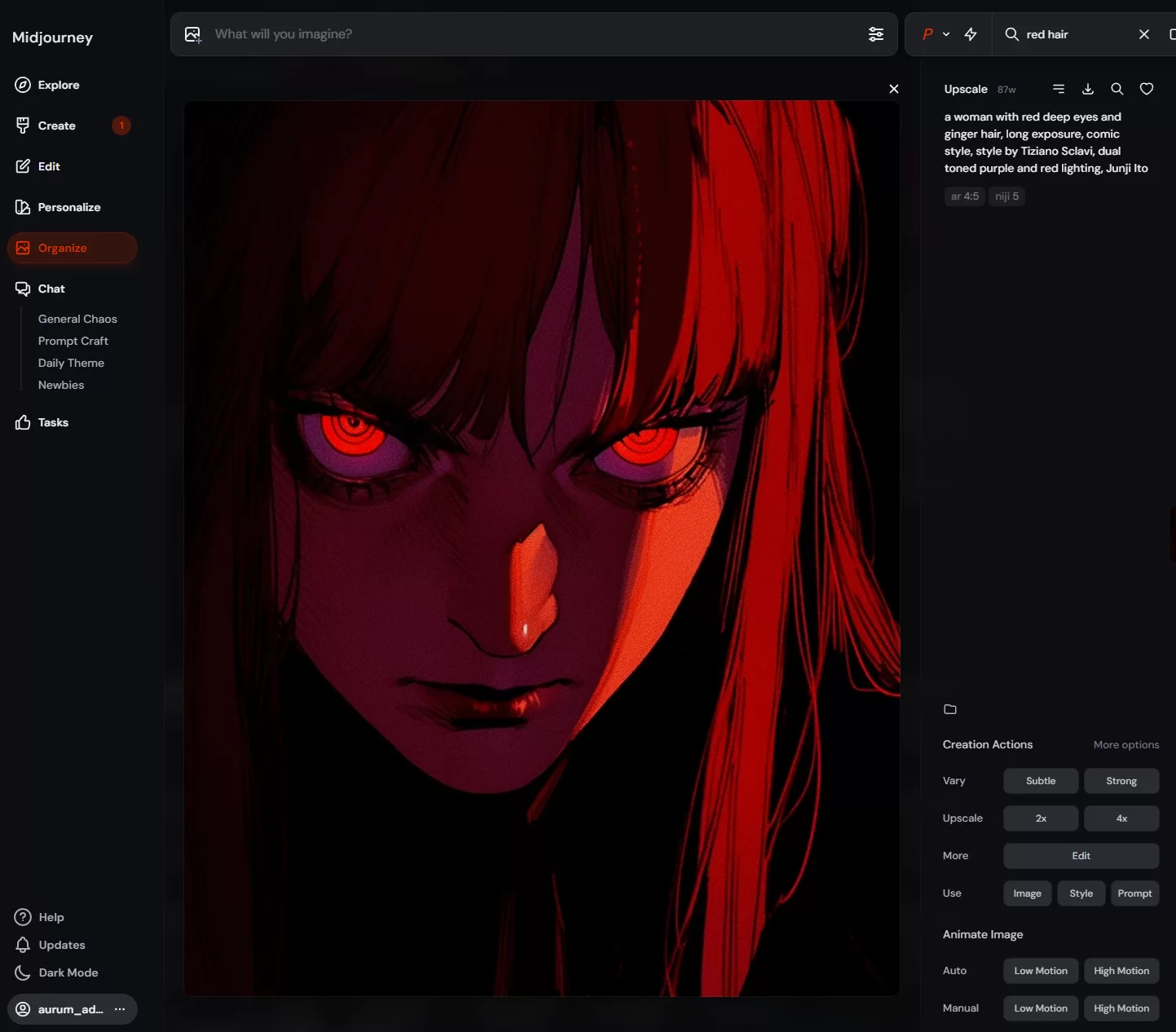
Some personal sides of this prompt, to ensure you it’s my work and where the inspiration came from: Tiziano Sclavi s an Italian comic book author, journalist and writer of several novels. Sclavi is most famous as creator of the comic book Dylan Dog in 1986, for Italian publishing house Sergio Bonelli Editore. To me, it’s a comic-series I re-read since my childhood and an artist whose style is embedded in my brain via Dylan Dog.
Junji Ito is a Japanese horror manga artist. Ito doesn’t rely on narration or what we in writing call “the Big Voice” nor does he use dialogue to convey fear. Instead, it’s his focus on keeping character designs simple and almost too cartoonish but keeping everything else detailed and almost super realistic, while having some of the most twisted depictions a human brain can think of. It’s disturbingly beautiful.
If you checked my art, you’d see these prominent horror topics repeating. I like focusing on something utterly unnerving but giving some beauty in it. The other “adjectives” in prompt, such as tone and dual lighting are just playing with effects in Midjourney’s –niji 5 model.
Again, I didn’t know who “Makima” was until I looked her up after receiving the takedown. Yet because the piece depicted a horror-style woman with ginger hair and red eyes, Crunchyroll claimed it. And Redbubble complied.
Why This Is Concerning, on a Personal Note
This situation goes far beyond a simple misunderstanding of having one image removed. As Redbubble says in the email, “Do nothing”. Just how ill-equipped current copyright enforcement systems are to handle the realities of generative art, and how easy it is for large companies to exploit those weaknesses to silence independent creators.
Let me be perfectly clear: this work was not randomly generated. It was built on intention, personal reference, and artistic influence. I crafted the prompt myself, designed to capture elements that are deeply personal to me — my appearance, my influences, and my aesthetic sensibility.
I am a ginger-haired woman. That is not intellectual property of my hairdresser’s dye.
I have red dyed hair, and my style is plain shirts, neutral tones, dark trousers. When Crunchyroll claims that my portrayal of a horror-styled woman with red hair and a simple outfit infringes on their property, they are not just misreading the image — they are ignoring the obvious: that likeness is my own, if they ever bothered to give a 1-min Google Search of what I do.
Why This Is Wrong, on a Societal Note
This isn’t just about me, but about how fundamentally broken this system has become. Neither I’m alone in this incident. The Disney & Universal lawsuit against MidJourney and other AI copyright lawsuits which we covered, is a clear indicator of the direction these corporations intend to take. Rather than confronting AI companies over how models are trained or how data is collected – which would be a complex but legitimate legal fight — they instead seek to claim ownership over broad, indefinable aspects of style, mood and aesthetic.
That is not copyright. That is control.
If Crunchyroll believes MidJourney’s training data unlawfully included their intellectual property, then their fight is with MidJourney. Not with me. Not with independent creators acting in good faith, who craft their own prompts and produce original outputs.
Going after artists like me is easy. It is inexpensive. It is intimidation, not protection. The best I can do is just not upload it anywhere and maybe take it down from other social media.
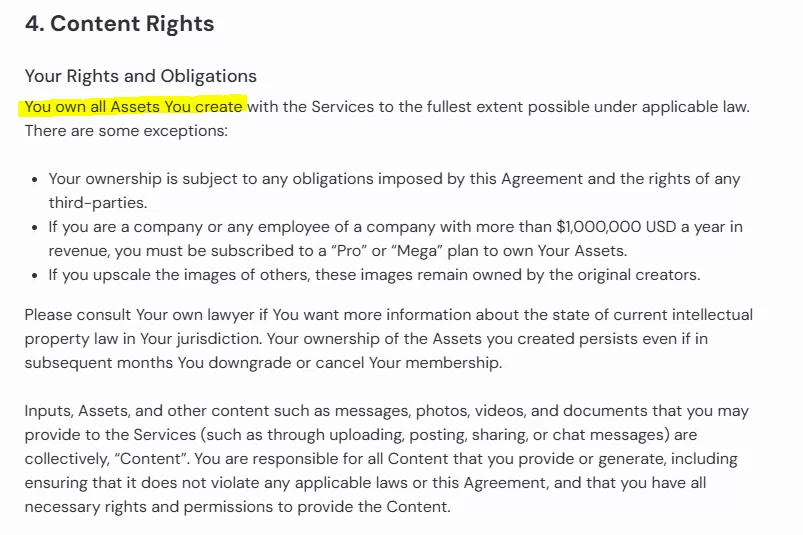
However, speaking into my protection here, I own that image under MidJourney’s Terms of Service, which clearly state in non-legalise language, but I’ll include an image the official ToS:
And yet, because my artwork vaguely depicted a horror-styled woman with ginger hair and red eyes – I was punished. Does that mean Crunchyroll could claim I’m infringing just for showing up to the office dressed like myself?
To me, my work is visually distinct from the Makima character and should have NOT been removed. If you have a different opinion, I’d love to hear some based arguments, not ad hominem.
This is what happens when platforms act as cowardly middlemen and rights-holders wield copyright like a weapon.
The Hypocrisy
What makes this even more absurd is the hypocrisy. In 2023, Crunchyroll settled a class-action lawsuit for Crunchyroll $16M class action settlement after being accused of violating the Video Privacy Protection Act (VPPA).
The lawsuit claimed Crunchyroll disclosed subscribers’ private viewing data to third parties, including Facebook (Meta), Google, and Adobe – without their consent. The settlement, finalized in late 2023, covered users subscribed between September 8, 2020, and September 20, 2023. Notably, Crunchyroll never issued a public statement to its audience addressing the settlement or acknowledging its practices.
So here we have a company that sold its own users’ private information without consent, paying millions to settle, now claiming to defend intellectual property against independent artists for creating something with a vague aesthetic resemblance.
The irony speaks for itself.
A Call to Creators
To every creator reading this who has faced a similar takedown, I want to hear from you.
If your AI-generated works have been unfairly removed, if you’ve been accused of infringement for creating something original, please, reach out. Share your story. You can comment, tag me, or message me directly, either here or via my social media. Your voice matters, and it deserves to be heard.
We follow the rules. We create in good faith. And we deserve better than to be trampled by corporate paranoia and legal bullying.
The more we stay quiet, the more they win.
The more we speak up, the harder it gets for them to get away with it.
Final Words
I do understand why Redbubble chose to comply, as they followed their policies and protected themselves legally. I don’t hold it against them. I will continue using the platform, as I have no bad experience with it otherwise.
But this is yet another example of mega corporations abusing their power at the expense of small creators. I’m done watching companies like Disney and Crunchyroll weaponize copyright to silence independent artists, especially when those artists had no intention, no knowledge and no wrongdoing.
I’ve had enough and I won’t stay quiet about it. From shadow banning darker topics, using “diminutives” for real life problems and the slop we consume in a 15s video. The bleached content doesn’t cause trouble and stir thoughts for sure.
If you’ve been through something similar, reach out. Let’s make it clear: we follow the rules and laws, but won’t be trampled quietly anymore. Not until all content loses meaning to brain-rot.