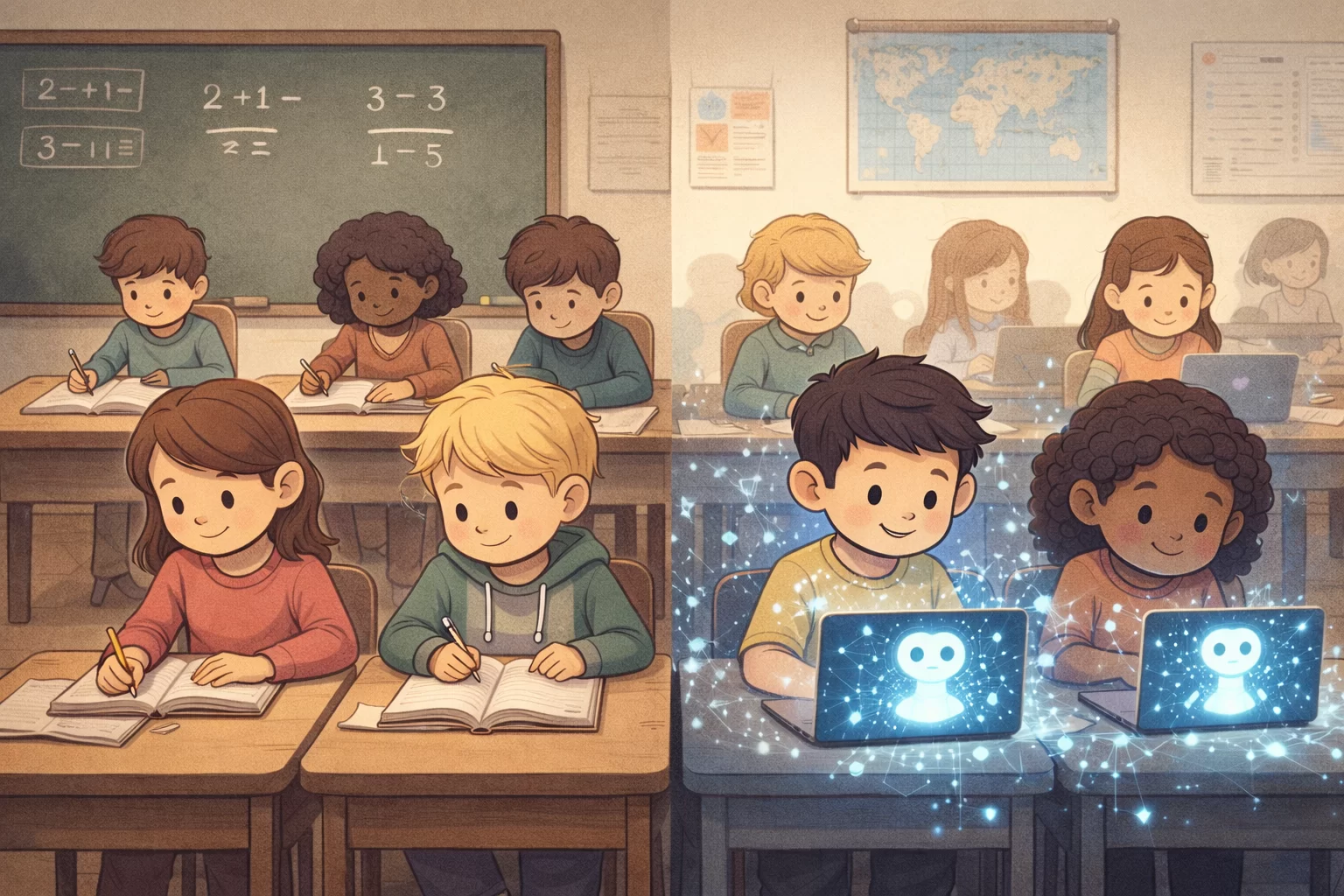
For decades, the digital divide described unequal access to technology: who had internet, better devices or faster connectivity. That framing is now becoming obsolete. Access is no longer the primary fault line. Do we really need a new educational system for AI literacy?
Generative AI tools are widely available, often free, being included into everyday software and search systems. With that, there is a new class divide rising, separating those who understand how AI systems work, how to question outputs and how to translate interaction into advantage, from those who merely consume responses and rely on sycophancy.
UNESCO and policy researchers increasingly describe this change as an “AI divide,” where inequality arises not from technological absence but from uneven literacy and material availability. AI literacy is becoming a form of educational capital, changing opportunity in ways comparable to access to higher education in earlier economic eras.
Disclaimer: This article is inspired by the ongoing need to promote transparent, critical and non-biased AI education as a public good rather than a privilege reserved for those who learn it by accident or profit. All opinions stated are personal and all studies cited are linked in the article.
AI Literacy as Educational Capital
Higher education historically functioned as a mechanism for stratification. Apart from the “package” of delivered knowledge, it trained individuals in methods of thinking in their separate fields for evaluation, synthesis, research navigation and institutional reasoning. AI literacy increasingly reproduces these same advantages. Studies show strong correlations between AI literacy, computational thinking and the ability to critically assess technological outputs. Students and professionals who understand prompting strategies, model limitations, and verification practices gain measurable academic and productivity advantages over peers using identical tools without conceptual understanding.
The distinction should not be labelled as intelligence, as it is meta-learning capacity. In effect, AI literacy trains individuals to think alongside machines rather than beneath them, using the cognitive benefits historically associated with university education.
AI in Public Education
At time of writing, a parallel educational structure is quietly emerging outside formal educational institutions. Research from the end of 2025 mentions that 92% of students use AI tools primarily to save time and improve work quality, yet only 36% receive formal guidance. Meaning that most students and workers adopt generative AI workflows without structured instruction, learning through experimentation, online communities or workplace necessity rather than curricula. Only a minority receive formal guidance on responsible or critical AI use.
This creates a gap, as AI education and literacy is learnt by professional or personal need, maybe even curiosity. This knowledge is informal, decentralized and unevenly distributed. Two populations begin to form despite equal access to tools. One learns to interrogate AI systems, verify outputs and integrate them into their cognitive reasoning processes. The other relies on AI as an answer generator, mistaking fluency for understanding and falling onto the trustworthiness of sycophancy. The difference mirrors historical disparities between structured higher education and under-resourced learning environments, where method rather than information determines long-term outcomes. If put bluntly, this table shows a clear line of two outcomes:
| Student Group | Learning Outcome |
|---|---|
| Students trained to question and verify AI outputs | Develop analytical reasoning and cognitive augmentation skills |
| Students using AI without literacy frameworks | Develop dependency and surface-level understanding |
The lack of formal, available institution education teaching how AI systems can be misused or critically interrogated in practice, has the side effect of rising use of these tools for illegal or delinquent uses. As we have previously discussed across multiple AI misuse debates, from AI erotica to the misogynistic image generation on Grok, to students informally competing over who can produce the most extreme low-effort “slop,” to the use of AI to endorse authoritarian ideologies.
Economic Mobility
I remember my parents saying “Study so you don’t have to work”. I find it quite the opposite, by pursuing better education, you are “specifying” yourself in a field. That may affect how many job opportunities in the field there are available in your vicinity and the lack of thereof. However, it is impossible to deny that opting for higher education gives you more economic mobility. That is hard to say how it will evolve with the AI technology. Some argue AI will exacerbate economic disparities, while others suggest it could reduce inequality by primarily disrupting high-income jobs.
What we can see though, is that economic consequences are already emerging. Studies from OECD examining AI adoption link advanced digital competencies with increased productivity gains and wage advantages, while workers lacking such competencies face heightened automation risk. The pattern resembles the university wage premium observed during late twentieth-century labor transformations, when higher education became a gateway to economic mobility. AI literacy may now operate as a credential without formal certification, silently influencing hiring decisions, workplace efficiency expectations and promotion pathways.
Individuals capable of leveraging AI as cognitive augmentation expand their output dramatically, while others risk displacement not because AI replaces them directly, but because peers learn to work faster, better and more strategically alongside it.
Access Does Not Equal Advantage
The critical misconception shaping public discourse is the belief that access alone guarantees equality. Research across digital education repeatedly shows that technological availability does not translate into meaningful advantage without literacy frameworks. AI just makes this more obvious, as nearly everyone can open a chatbot interface and type words, but only some users learn to refine prompts, cross-check hallucinations, interpret probabilistic outputs, or recognize embedded biases.
Instead of funding transparent education, some administrations do the opposite, such as the Trump administration cutting 2.75 billion in funding for the Digital Equity Act, claiming the funding was unconstitutional and “racist,” despite the fact that over 90% of the population in rural states such as West Virginia, Vermont and Mississippi fall under covered categories eligible for funding.
Cancelling the digital equity portion of funds outright has not only been called legally dubious but has also jeopardized funding for local organizations that were preparing to provide Americans with digital literacy training, workforce development programs, technical support and free or low-cost computers. The more you know, the more you can think and analyse.
What else widens the gap?
Beyond education and access, several practical conditions also influence AI literacy development. Access to adequate equipment affects how frequently individuals can interact with AI tools in meaningful ways. Financial resources shape exposure to higher-quality services, learning materials, and professional environments where advanced use emerges. Existing levels of digital literacy determine whether users can interpret outputs critically rather than accept them at face value. The quality of institutional or educational support influences whether AI is learned systematically or through fragmented self-teaching. Age-related differences affect confidence and adaptation speed, while gender dynamics continue to shape participation and engagement in technological spaces. Privacy awareness further impacts literacy by influencing how and whether individuals choose to interact with AI systems at all.
Together, these factors act as additional influences on who develops deeper AI literacy and who remains at the level of basic use. These statements deserve a topic of their own, so now I will just mention them, until future research is published.
Early Education and False Mastery
The gap begins forming early. As the Guardian puts it in “Generation AI”, children are growing up as AI natives and experts say computing skills should be on par with reading and writing.
With that, we can go back to comparing that children and students are increasingly exposed to AI systems before receiving instruction on how they function. Surveys show widespread AI usage among students who lack even basic understanding of model mechanics or limitations, especially when under pressure of deadlines. This produces a phenomenon described as false mastery: reliance without comprehension. Without structured AI education comparable to foundational literacy or numeracy, early advantages compound over time. Those taught to question AI develop analytical resilience to sycophancy, while others internalize outputs as authoritative knowledge. Experts, in this example, from the OECD Digital Education Outlook 2026, increasingly argue that AI literacy must become a core educational competency to prevent long-term social stratification driven by technological misunderstanding rather than ability.
Do We Need a Parallel Education System?
Taken together, these dynamics suggest that AI literacy functions as a parallel education system operating alongside universities rather than replacing them. Traditional education teaches research methods, structured reasoning and disciplinary thinking into a field-specific topics. AI literacy teaches prompt engineering, verification strategies, model evaluation and cognitive augmentation. A person needs to be able to verify and distinguish a hallucination from the truth, which is becoming harder daily.
Universities historically created scarcity through institutional access; AI literacy scales globally but unevenly, accelerating this inequality formation. The result is a rapidly emerging hierarchy defined not by who uses AI, but by who understands it deeply enough to shape outcomes, no matter if that is personal or profit gain.
Society spent a century expanding access to higher education to mitigate inequality. AI may now recreate a comparable stratification within a single technological generation, faster, quieter and largely unnoticed until its consequences become societally structural.