I was watching the Super Bowl when Amazon’s Ring advertisement aired. Lost dog posters, soft lighting in a cozy suburban, a child smiling as the new AI feature helped track their pet back home. The ad was designed to land emotionally, and it surely did. As someone who loves animals more than people probably, my first reaction was simple: this is useful and cute. If my pet ever ran off, I would want every available system helping me bring them home.
But curiosity has a habit of breaking simplicity. Once I began reading about Ring, I replaced the warmth with something stuck in my throat. That is not outrage, paranoia or fear. Is this another recognition of AI being used as a tool for surveillance, delivered in a way to be acceptable and even loved by people. In this case, packaged as a pet recovery tool, a public demonstration of distributed AI vision infrastructure integrated across private neighbourhoods.
And I would get it if this comes from an experimental startup. However, Ring is owned by Amazon, one of the most data-saturated corporations in the world, casually introducing large-scale visual coordination to millions of viewers during one of the most watched events of the year in the US and worldwide. The feature that triggered my reaction is called Search Party. What’s behind all this?
What is “Search Party” feature?
According to Ring, the system operates through a straightforward workflow. A pet owner reports a missing dog through the Ring app and uploads photos. Ring’s AI then scans footage from nearby outdoor Ring cameras for visual matches. If the system identifies what it believes to be a similar-looking animal, the owner of that camera receives a notification and may choose whether to share the relevant footage with the pet owner.
Ring states that the feature does not process human facial recognition and that footage is never automatically shared. The company highlights consent-based participation and points to early success metrics, with Amazon CEO Andy Jassy stating that the system helped reunite 99 lost dogs within its first 90 days.
Taken at face value, the system is limited, purpose-specific and voluntary. The deeper issue, however, is not the stated intent of the feature. It is the architecture required to make it function. Coordinated visual scanning across decentralized, privately owned cameras requires a robust AI pattern-recognition layer and a networked cloud infrastructure capable of orchestrating distributed detection.
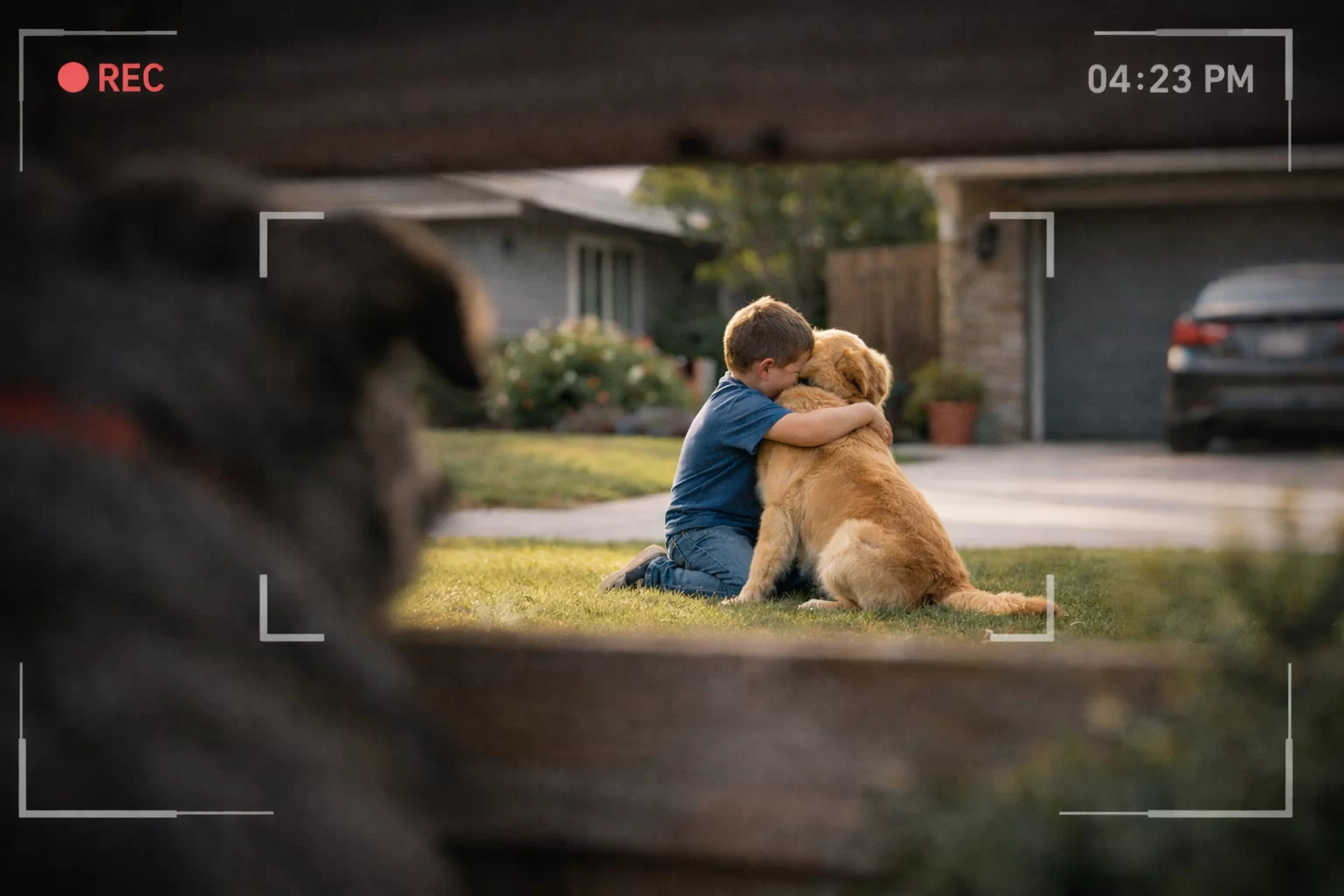
The technical difference between identifying a dog and identifying a human when the capability layer is already in place is a red flag. People move through neighborhoods every day, walking their dogs along streets, through gardens and parks, spaces where even the dog behind the next fence can see them pass.
About the Ad
The Super Bowl advertisement is a good old selling sentimental story. Call me bleak, but if I strip the cuteness, it shows a neighbourhood operating as a unified visual organism for an AI system. A dog moves through space and multiple cameras register, notify and coordinate. Individual homes function as nodes within a larger detection grid, each device contributing perspective to a shared outcome. I took the images from the ad on YouTube to clearly show the meaning of this article:
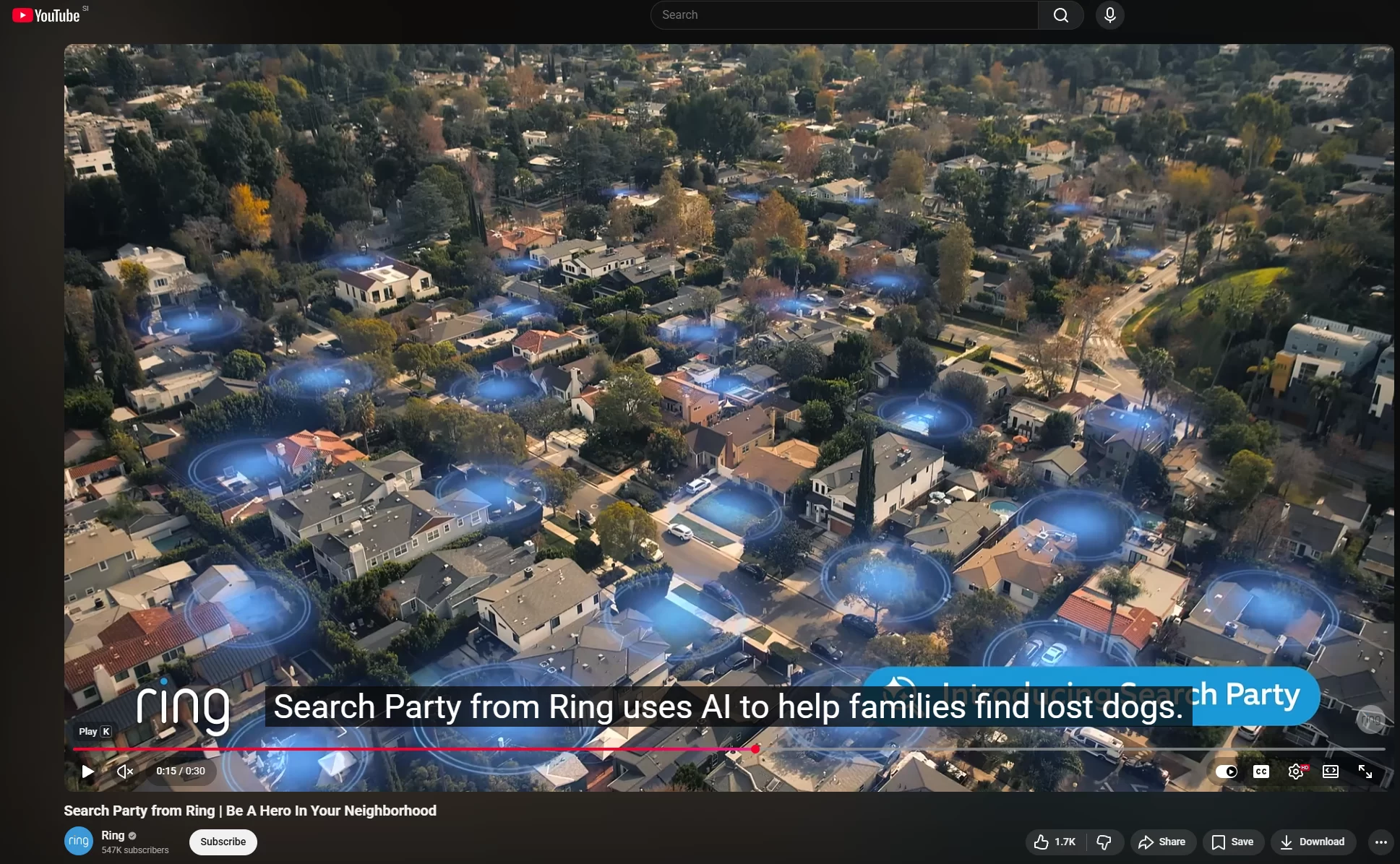
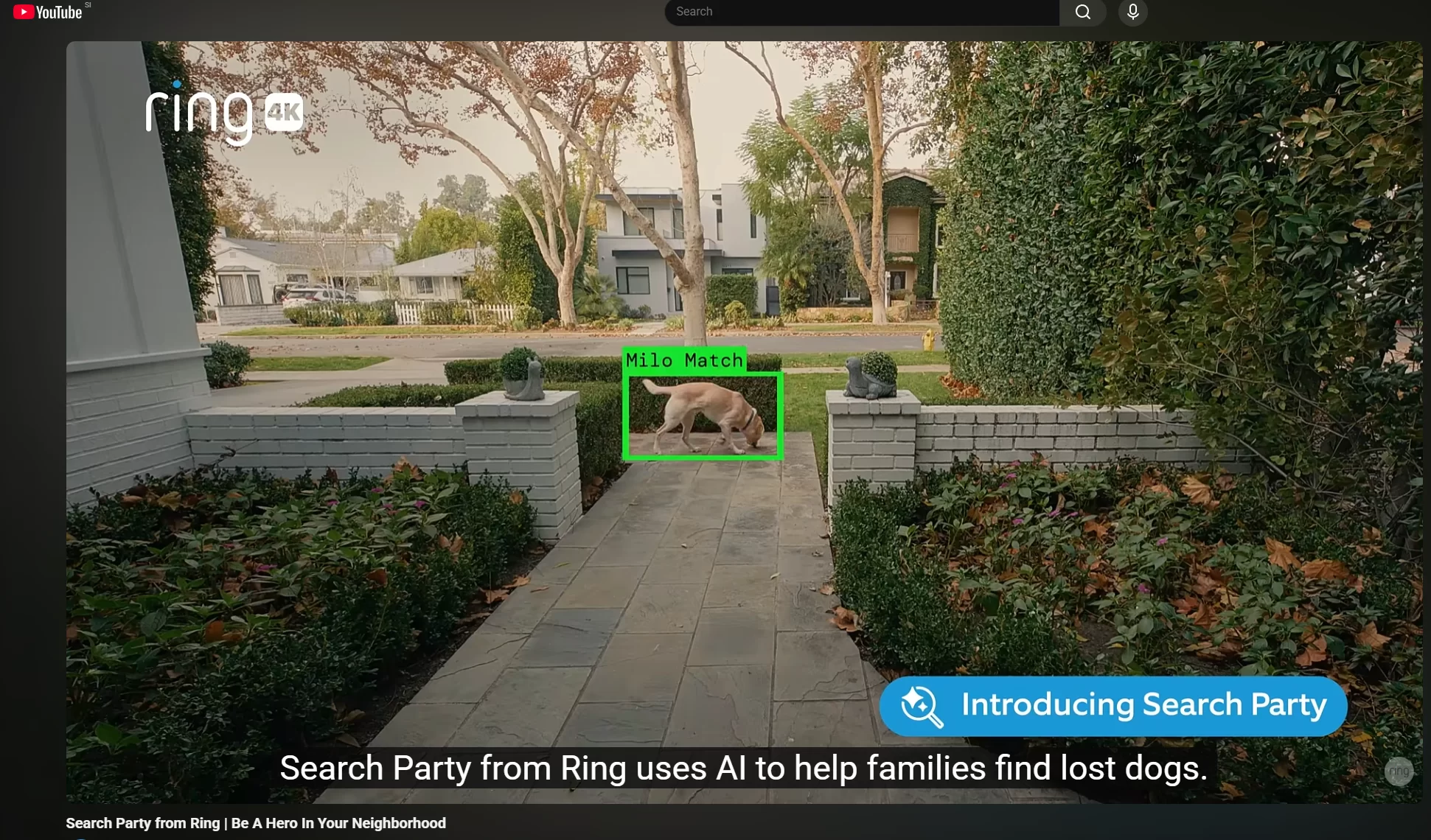
For many viewers, especially dog owners, the emotional framing dominates because of the fear of this very real situation happening. Some structural implications were immediately apparent, to both people and lawmakers. The Search Party feature for now is only available in the US, so I will be focusing on those statements.
For example, Senator Ed Markey criticized the ad, arguing that if a network can automatically scan for dogs, the boundary between that and scanning for people rests on policy rather than technical limitation. That observation resonated widely online, where reactions ranged from mild discomfort to outright media panic about how such systems might evolve.
The advertisement is promoting a useful feature, no denial there. It makes the feature seem comforting and benign. On the other hand, the Ring company is owned by Amazon and Jeff Bezos. The same Amazon you order on frequently, is normalising an AI system with capabilities of scanning and recognition. In a personal opinion, Ring is the most adorable way to excuse blatant mass surveillance, considering the rising trends in that software area.
Ring’s History with Law Enforcement
Digging a deeper into the roots of Ring development, the company previously developed structured portals through which law enforcement agencies could request footage from users. In 2023, Ring paid a settlement to the Federal Trade Commission over privacy failures that allowed overly broad access to customer videos, by allowing any employee or contractor to access consumers’ private videos and by failing to implement basic privacy and security protections, enabling hackers to take control of consumers’ accounts, cameras and videos.
More recently, Ring announced a partnership with Flock Safety, a surveillance technology firm known for automated license plate reader systems that integrate with law enforcement databases. Given current events, such as numerous ICE protests around US, people were particularly worried that such a partnership could lead to AI identification and arrest, especially because that already happened in 2024, with another Amazon device. Although Ring later cancelled the partnership following public criticism and stated that no footage had been exchanged, the situation reinforced concerns about the direction in which such integrations could move.
Organizations like the Electronic Frontier Foundation have long argued that Ring’s evolution reflects the normalization of privately owned camera networks gradually interfacing with institutional surveillance structures. Police can still get videos from security companies, typically through either a warrant signed by a judge or by making a special life-or-death request to companies.
Who is looking at your videos?
Ring states that Search Party is consent-based, does not use human facial recognition, and allows users to manage participation through privacy settings. Footage is only shared if a camera owner actively agrees after a match is detected. Search Party appears to only use saved videos in Ring’s cloud. It won’t start recording new video that wouldn’t otherwise be triggered by your motion detection settings, and it doesn’t seem to use live camera feeds.
The only way other people can see your saved Ring videos is if you receive a notification that someone has started a Search Party in your area and one of your videos has a match. Then you have to specifically agree to send that video to the person who started the Search Party. All in all, you have to be very familiar with the software to know what exactly to opt out from as a user.
As for Ring specialists viewing videos, the company has laid out a clear policy: “Employees are not able to view, access, or control live streams. To help improve Ring’s products, services, and technology, our research and development team views a small number of video recordings. These video recordings are either from users who have made them publicly available (by posting them on Neighbours or otherwise on the Internet), or from users, team members, and their friends and family who have given us explicit permission to use them for this purpose (which they may revoke at any time).”
Ring is presumably using these publicly available videos to train its AI.
Tools for purpose
Helping reunite lost pets is a legitimate benefit. For families who have experienced the panic of a missing animal, the value is immediate and human. If you’re a dog owner considering Search Party, take the time to understand your privacy settings, review what’s enabled by default, and decide consciously what level of participation you’re comfortable with.
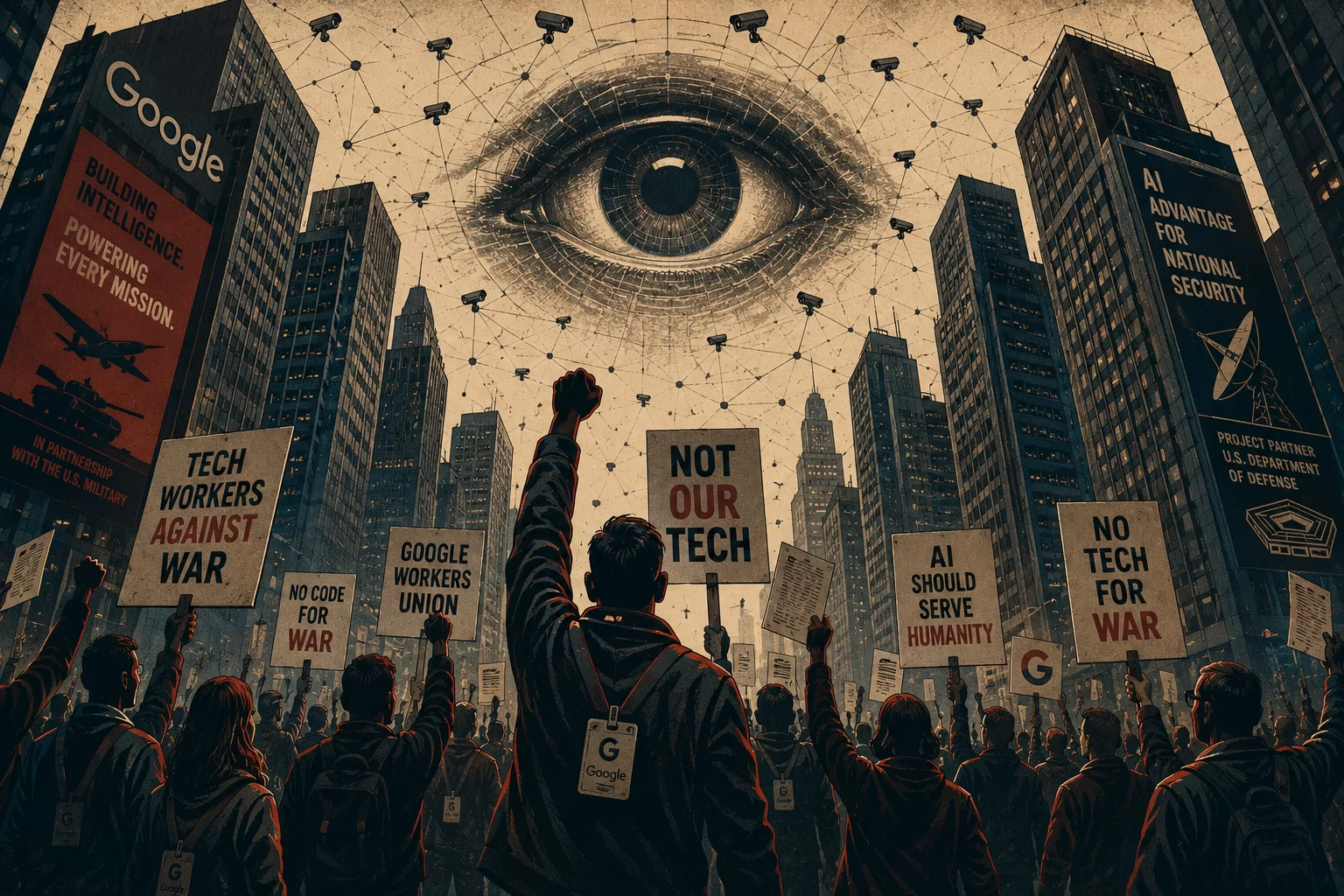
Historically, surveillance tools are rarely made for their original purpose. License plate readers move beyond traffic enforcement. Facial recognition goes beyond mobile device unlocking. Data collected for one function becomes available for another. Institutional incentives and corporate interest can always shift. We have previously talked about the mix of civilian and military software and it’s normalisation through media.
If a problem is disguised as a solution, it easily becomes ordinary and acceptable, in this case even adorable. If a lost dog can be tracked across a neighbourhood by AI software, who determines the boundaries of its application, and under what oversight mechanisms are those boundaries enforced?
Mass surveillance does not need violence or radical changes. Sometimes it comes wagging its tail.