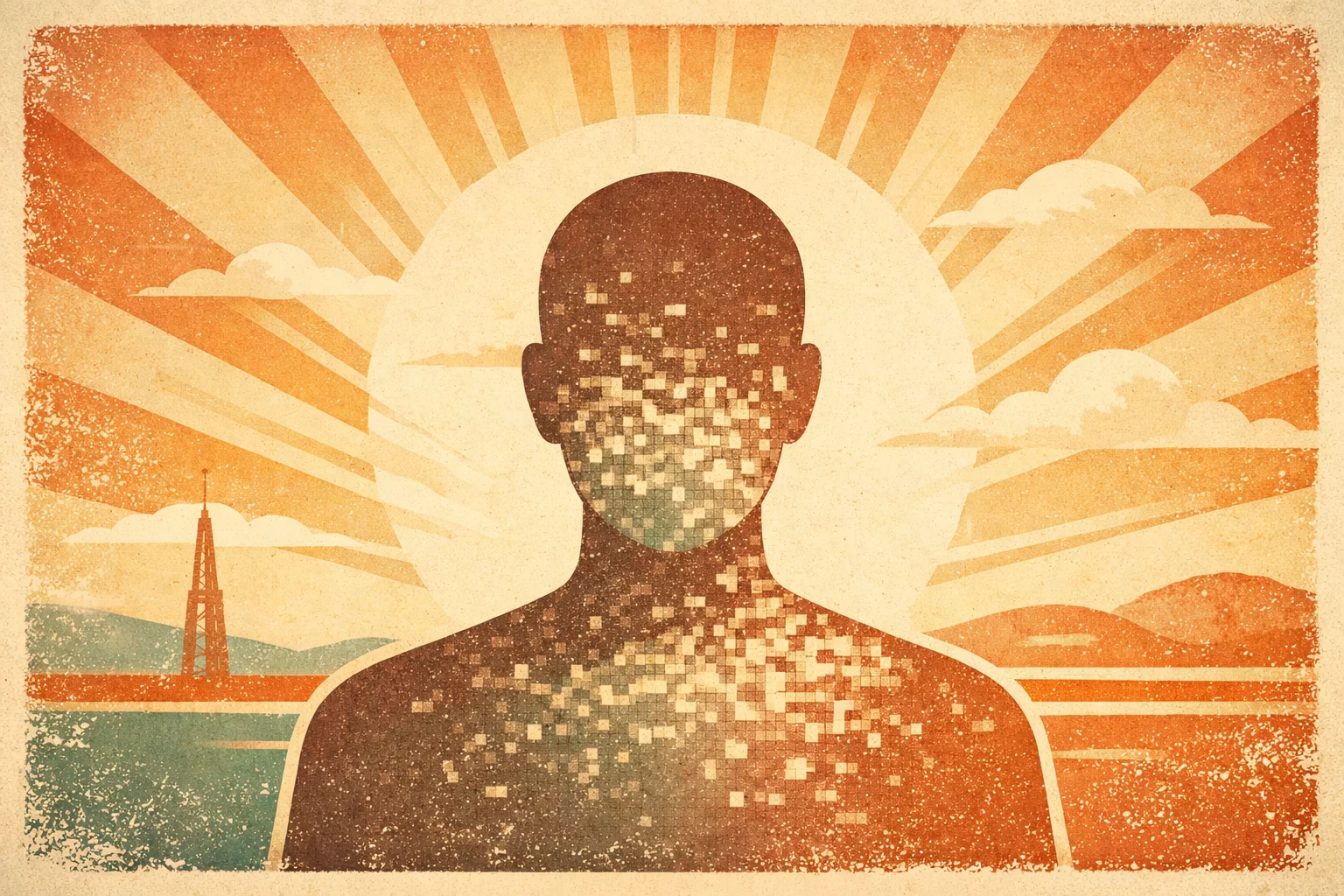
Human societies have always struggled with the finality of death. From monuments designed to outlast civilizations, to post-mortem photography and spiritualist traditions, the desire to preserve presence beyond biological life has persisted across eras. Across history, this impulse has taken material form through objects meant to endure. Pyramids, tombs, portraits, relics, photographs, recordings. Each era developed its own technologies to preserve traces of presence beyond the body. What changes when technology starts generating the dead anew through AI resurrection?
Some data and terms I’ll be examining from the article Artificially Alive: An Exploration of AI Resurrections and Spectral Labor Modes in a Postmortal Society. In such a society, death does not remove individuals from social circulation. It converts them into digitally mediated presences capable of operating within emotional, cultural and political systems long after biological life has ended.
Disclaimer: The following analysis examines AI resurrection practices from a critical and research-based perspective. References to real-world cases are used solely to illustrate technological mechanisms and ethical risks, not to justify or promote their use.
Memory and re-presencing
Traditional remembrance acknowledges absence. It accepts that the dead cannot respond. AI resurrection rejects that premise. Using the digital remains accumulated during life (voice memos, videos, texts…) AI generative systems synthesize presence rather than preserve memory. The resulting entities are not parrots of the past, but are able to generate new speech, reactions, and interactions that simulate agency in the present.
The authors describe this process as re-presencing. The dead are no longer referenced as historical subjects but positioned as active participants within contemporary communication.
This distinction is fundamental. Memory preserves what was once expressed. Once generative speech replaces archival recall, identity becomes malleable. Authorship no longer ends with death. It shifts to those who control the systems capable of speaking on the deceased’s behalf.
The operational modes of AI resurrection
The article identifies 3 dominant modes through which AI resurrection currently functions: spectacularization, mundanization and sociopoliticization.
Spectacularization
In the first mode, deceased public figures are digitally revived for entertainment, cultural ceremonies and national events. Singers perform new songs. Actors reappear on screen. Historical figures are summoned to reinforce collective identity.
Although framed as tribute, these revivals reposition the deceased as ongoing cultural assets. Their likeness becomes commercially productive beyond death, circulating through performances, licensing and media distribution. This is not so different from existing holograms of celebrities performing or similar activities.
The point is, that resurrection here operates as spectacle. The audience is invited to marvel simultaneously at the figure returned and at the technological power capable of reconstructing them.
Mundanization
The second mode brings AI resurrection into everyday life. Through conversational agents, avatars and digital doubles, individuals maintain ongoing interactions with deceased loved ones. These systems simulate familiarity, emotional responsiveness and continuity of relationship.
Grief is no longer framed as a process oriented toward acceptance of loss. Instead, it becomes an ongoing mediated relationship, with monetized interactions.
The article emphasizes that this transformation alters the societal and psychological structure of mourning. Death does not end bonds. It suspends them indefinitely through algorithmic presence. I wonder, this cannot be healthy, especially not long term.
Sociopoliticization
The most destabilizing mode emerges when AI resurrection enters political discourse.
During the Israel–Hamas war, GenAI tools were used to recreate fallen Israeli soldiers and police officers. These videos depict the deceased speaking directly to loved ones, reaffirming patriotic conviction, legitimizing sacrifice and endorsing the moral framing of the conflict.
These statements were generated after death. As the article notes, relatives effectively speak on behalf of individuals who can no longer express or revise their own beliefs.
In stark contrast, activists in Gaza used GenAI to recreate the nine children of Dr Hamdi al-Najjar, killed in Israeli airstrikes in Rafah. In these videos, the children are digitally reanimated to plead for an end to the killing of other children.
Different political positions, different narratives, identical propaganda mechanisms?
In both cases, AI resurrection transforms death into testimony. Not historical testimony grounded in recorded speech, but synthetic moral messaging constructed for the present use. The authority of such messages derives from the moral weight of the speaker’s death. And so simply, grief replaces scrutiny and emotional reactions displace evidence.
The AI afterlife industry
Mundanization, or normalization, is not incidental. It is supported by a growing commercial ecosystem dedicated to posthumous continuity.
Companies including Eternal Me, Forever Identity, StoryFile Life, Eternos and ELIXIR AI offer services designed to preserve and simulate personal presence after death. These platforms promise continuity, companionship, and digital legacy through interactive avatars and conversational systems. For example, ELIXIR AI markets digital immortality by promising to create an eternal doppelganger from a customer’s lifetime data, with the slogan: “We can now live better, live forever”. What they produce is not an archive but a generative persona.
Once integrated with large proprietary language models, these digital entities are capable of responding to new questions, offering advice and expressing views on events that occurred long after the individual’s death. They promote that you can brag to your grandma about your new girlfriend. However, the system no longer reflects what the person said, it just extrapolates what they might have said.
This shift carries structural consequences. Consent is blurry, as no individual can meaningfully authorize future uses of technologies and contexts that do not yet exist. Ownership of identity becomes legally ambiguous, suspended between property rights, data protection and post-mortem privacy. On the other hand, emotional dependency becomes embedded in paid platform design, as continued interaction replaces resolution of loss.
This analysis follows the same pattern observed in previous research on AI emotional design, dependency loops and synthetic reassurance. Systems built to feel comforting, empathetic, or meaningful consistently bypass critical judgment. AI resurrection does not break from that trajectory. We did talk early in 2025 about griefbots and data privacy, but I did not think the industry would gain so much traction in a year.
Spectral labor and posthumous exploitation
Through generative systems, the dead are compelled to perform emotional, cultural and political work. Their likeness produces affect. Their voice produces persuasion. Their memory generates value.
The article conceptualizes this condition as spectral labor. This labor is involuntary.
Unlike living subjects, the deceased cannot withdraw consent, renegotiate representation or object to reinterpretation. Their digital remains circulate as productive entities shaped by the goals of families, institutions, activists, platforms and corporations.
Most critically, the dead become renewable resources. Their likeness and affect can be updated, circulated and monetized indefinitely.
The unresolved boundary
What makes AI resurrection uniquely dangerous is the emotional intensity and the regulatory absence. Existing legal frameworks were designed for living subjects, static data and finite consent. They cannot govern systems that continuously generate new speech in the likeness of the dead.
Post-mortem consent cannot meaningfully extend to future technologies, political contexts or commercial uses that did not exist at the time it was given. Nor can others ethically inherit the right to author beliefs on behalf of someone who can no longer revise or refuse them.
The dead do not return as they once were.