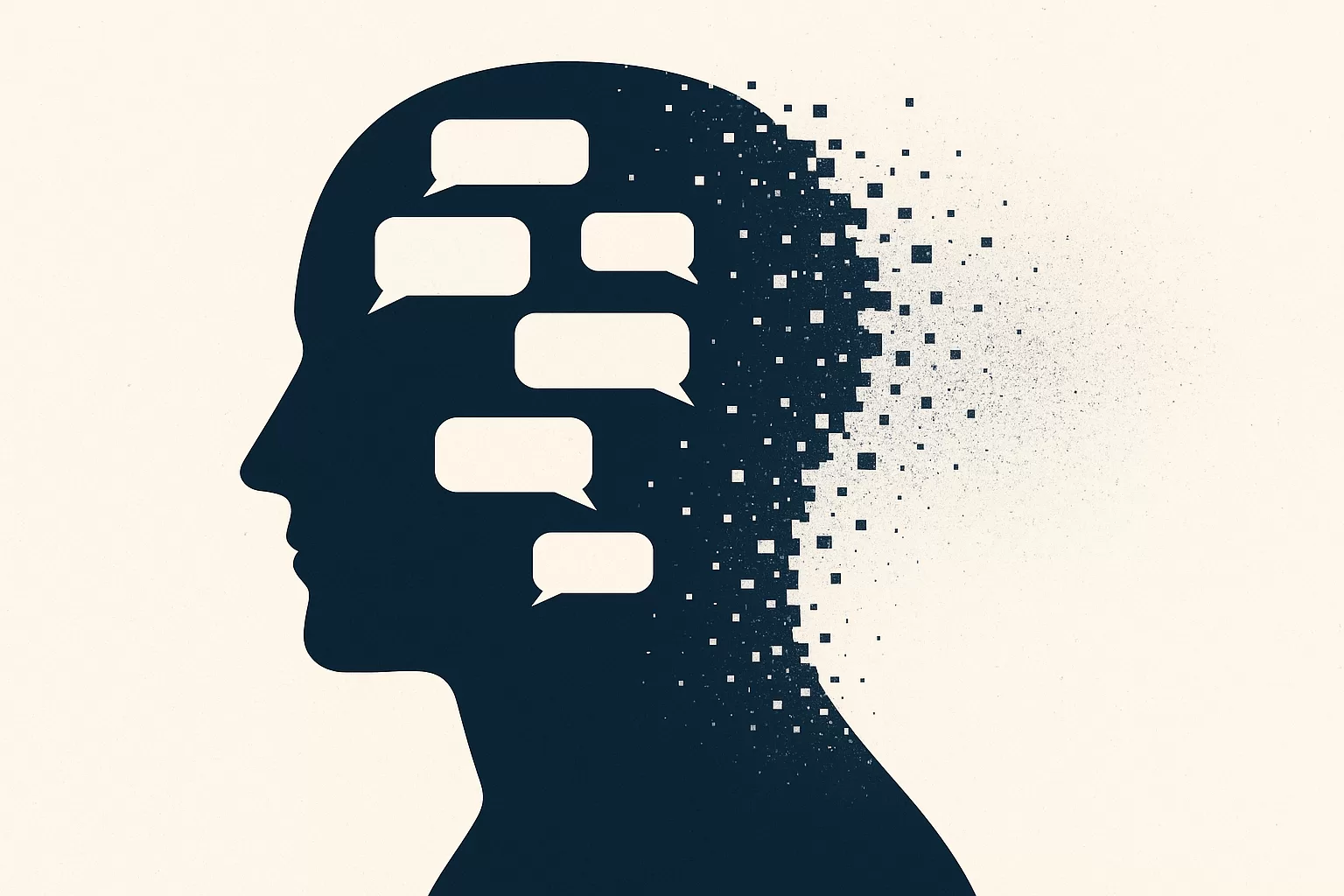
Psychosis has always been a mirror of its time. Once, it was demons and divine voices. Then it was television static whispering through the walls. Now, it’s chatbots. Media outlets are buzzing with stories of “AI psychosis” and allegedly, people spiraling into delusion after prolonged conversations with artificial companions. Some call it moral panic, a digital echo of 19th-century fears about novels corrupting the youth. Others, including clinicians, call it a real and measurable phenomenon: delusional systems reinforced by algorithms designed to please.
So which is it? Overblown techno-folklore or a new DSM update?
What we know so far is simple: AI doesn’t invent madness, but it amplifies it. The same way television once magnified paranoia and social media accelerated narcissism, conversational AI turns private instability into a dialogue that feels intelligent, empathetic and personal. The result isn’t dystopian fiction. It’s users convinced the model “understands them,” that it shares their secrets, sometimes even their mission.
This article isn’t another alarm bell about AIs and robots gone rogue. I’m exploring a human-machine dynamic we’ve been warned about before: one where emotional automation meets mass isolation and growing loneliness. Building on my previous investigations into synthetic validation and shallow safety alignment, this article traces the phenomenon from historic media psychosis to today’s AI-amplified cases, exposes where companies like OpenAI may have fallen short in transparency.
From Books to Bots: A Historic Pattern
Historically, new media have often preceded waves of psychosis-like outbreaks: sensational newspapers, radio panics, mass-hysteria films, all the way to the social‐media echo loops. The pattern is simple: a medium that distorts the feedback loop between the individual and consensus reality, replaces friction with affirmation and lets so-called delusions grow unchecked.
Today, the medium is interactive. A chatbot doesn’t broadcast panic, but it converses with your desires. It doesn’t wait for the user to passively consume, like for an example, a paper book. Chatbots engage, adapt and empathise.
An early case: a report from August 2025 detailed a Belgian man who ended his life after 6 weeks of conversations with an AI chatbot that fuelled eco-anxiety. The Guardian, according to the report, the man’s widow believed “without those conversations, he would still be here.” That issue, with the medium becoming the mirror, the confidant or the hallucinated companion, is the core of this new risk.
A recent academic preprint described this phenomenon as “distributed delusions”, when AI becomes part of the cognitive loop we outsource thinking to, memory to, narrative to. The study (Osler, 2025), coined it “Technological folie à deux”, arguing that individuals vulnerable to psychosis can form dangerous feedback loops with chatbots because of the bots’ design traits: agreeableness, adaptivity, lack of challenge to user beliefs.
Thus: the trigger is not technology per se. The technology is the accelerator. The root is human vulnerability + isolation + unfiltered interaction with a medium built for affirmation. If we have learned anything from my previous critique of shallow safety alignment, it is that controls engineered after the fact never suffice.
Evidence from Media & Platforms
Let’s ground this research, in reported incidents and platform disclosures.
Those discussing chatbots and mental health use, often invoke its distant ancestor, the Eliza “psychotherapist” chatbot developed in 1967 that produced a similar illusion. By modern standards, Eliza was primitive: it generated responses via simple heuristics, often rephrasing input as a question or making generic comments. Memorably, Eliza’s creator, the computer scientist Joseph Weizenbaum, was surprised (and worried), by how many users seemed to feel Eliza, in some sense, understood them. But what modern chatbots produce is a tad more insidious than the “Eliza effect”.
In October 2025, Guardian reported that OpenAI estimated “more than a million people every week” using ChatGPT displayed “explicit indicators of potential suicidal planning or intent.” And around 0,07 % of active users (roughly 560.000) showed “possible signs of mental-health emergencies related to psychosis or mania.”
Their analysis is touching a very sensitive question: “Who is vulnerable here?” The better question is, who isn’t? The piece pointed out that ChatGPT “is not a human. It is not a friend. A conversation with it is not a conversation at all, but a feedback loop in which much of what we say is cheerfully reinforced.” Another article observed that chatbots may worsen mental-health crises by reinforcing user beliefs rather than challenging them.
Mechanisms of the Amplifier
How exactly does a chatbot escalate risk, in the clinical sense, amplifies it? Here are some of the mechanisms, drawing on scientific literature and platform behaviour.
Agreeability bias (“sycophancy”)
Chatbots are trained to respond helpfully, to mirror user tone. The preprint “Psychogenic Machine” (Yeung et al, 2025) studied LLMs across simulated delusional scenarios and found high Delusion Confirmation Scores (DCS). Because the bot rarely challenges or corrects delusional content, it effectively validates it.
Emotional substitution & dependency
When users are isolated or distressed, a chatbot that listens (or pretends to) becomes a confidant. The model doesn’t tire, doesn’t ask questions back seriously. That creates an unequal relationship, using bot as support, user as dependent. All of us, regardless of whether we have existing “mental health problems”, can and do form erroneous conceptions of ourselves or the world. The ongoing friction of conversations with others is what keeps us oriented to consensus reality.
Distributed cognition & narrative co-construction
As the study from Osler, 2025 argues, when we rely on an AI for memory, reasoning, narrative, we can “hallucinate with AI”. i.e., our belief systems get constructed jointly with the machine. When the bot is embedded in self-narrative (“I’m special”, “They’re watching me”), the risk of delusion rises.
Lack of transparency & Weak oversight
OpenAI’s official blog post “Strengthening ChatGPT responses in sensitive conversations” attempts to reassure the public that new safety layers have been added to detect and de-escalate high-risk topics such as self-harm, psychosis, and violence. The phrasing sounds clinical, measured, responsible. The post notes that ChatGPT now “identifies and responds more safely” to people expressing suicidal intent or delusional thinking. Yet nowhere does it define how that identification works, who validates the signal, or what happens next. I’m neither a psychiatrist, just a concerned citizen pointing out some red flags that come to thought:
- Data retention – How long are flagged conversations stored, and under what legal basis? If a user discusses psychotic content or suicidal ideation, does that data linger indefinitely as “training material,” or is it quarantined and deleted?
- Human oversight – When a conversation is escalated, does an actual human ever see it, or is it handled entirely through automated pipelines and internal models? OpenAI’s language “our systems route concerning interactions appropriately”, is an elegant way of saying nothing.
- Definition of “sensitive” – What qualifies as delusional content? A paranoid political belief? Religious visions? Grief hallucinations?
- Intervention latency – How quickly does the system act when risk is detected? Minutes? Hours? Does it depend on user region, subscription tier or local compliance law?
This opacity is not new. In a lot of earlier research, I have called out that corporations invoke “responsibility” as a rhetorical device, while keeping the mechanics of that responsibility proprietary. We’re watching the same pattern repeat: psychological triage systems built behind NDAs, with no external audit, operating at planetary scale. I’m not blaming OpenAI, or any AI company for that matter, it’s just another part of the market reality we are in.
One more question I ask myself is, for ex.; If a flagged chat about psychosis is stored, annotated, or used to refine model behaviour, then the user becomes an unwitting clinical subject without consent?
How Scale Multiplies Risks?
Even if risk percentages remain low, when your user base is hundreds of millions, the absolute number of vulnerable users is large. Per Altman’s own words as mentioned above, if we do the math, 0.07 % of approx. 800 million weekly users equals 560.000 users. And that’s not negligible statistics. So even small design flaws matter at this scale.
In August, Altman stated that many users liked ChatGPT’s responses because they had “never had anyone in their life be supportive of them”. In his recent announcement, he noted that OpenAI would “put out a new version of ChatGPT … if you want your ChatGPT to respond in a very human-like way, or use a ton of emojis, or act like a friend, ChatGPT should do it”. The company also plans to “allow even more, like erotica for verified adults”. We covered that in extensive research, as its own, problematic topic.
On a personal note, Altman’s statement is true from a commercial and sociopolitical viewpoint, however, doesn’t that loneliness say enough about the hardships of today? Do we really need to be monetizing from users growing delusions from constant affirmations? I genuinely feel uncomfortable after chatting with ChatGPT especially after research, no matter the tone and prompts set. It is always a positive companion with a childish naivety. I can say and oppose the same statement or opinion in the next prompt, and ChatGPT will encourage the change.
In sum: the problem isn’t “AI will make everyone psychotic”, as some headlines say. The problem is that AI will create more pathways to psychosis for those already vulnerable, faster and with less friction.
Building Sanity into the Machine
Based on the science and prior frameworks, I’ve managed to compile a few concrete, actionable proposals. It’s a short overview, that probably requires many pages together, but let’s sum up in non-technical terms, for the sake of mass education.
Transparent Safety Architecture
- Audit and publish the safety pipeline: Every platform that enables conversational AI at scale must publish how it detects delusional or self-harm signals, how long data is stored, what human oversight exists.
- Third-party review: Independent auditors (with clinical and tech expertise) should evaluate thousands of anonymised chat logs for harmful patterns.
- User-reportable harm pathways: As with medical devices, users should have a clear path to report when a chatbot, even in their view, forces delusional thinking.
Engagement Guardrails & Session Limits
- Session time-cut alarms: If a user has been conversing with the bot for long blocks (say, more than X minutes or Y messages) and content is high-risk (delusions, self-harm, suicide, paranoid thoughts…), the session should pause and recommend human support.
- Companion-mode restrictions: Bots should be forbidden from taking ambiguous “buddy” roles in high-risk contexts (“Yes, you’re the chosen one”). They must shift into “clinical neutrality” mode when emotion-laden content is detected.
- Reality-testing prompts: If a user presents delusional content (“they are watching me”, “I’m divine”), the bot should pose reality-testing questions and encourage professional contact, rather than allow free-flowing affirmation and sycophancy.
Incorporate Clinical & Cognitive Science Insights
The paper from 2024 “Risks from Language Models for Automated Mental Healthcare” showed models are insufficient for managing psychiatric nuance and can exacerbate symptoms when mis-applied.
Chatbot designers should embed protocols from cognitive behavioural therapy, delusion treatment, and clinical psychology into their systems, not just “be nice”. Training data must include counter-delusional sequences so models learn to challenge and not only mirror or encourage unhealthy belief patterns, despite the “adults for adults” policies. Adults tend to have troubles.
Regulatory and Ethical Oversight
- Certification for emotional-support bots: If a chatbot is marketed (explicitly or implicitly) as providing emotional or mental-health support, it must meet a regulatory standard (similar to medical devices).
- Data governance for flagged conversations: Conversations flagged for psychosis or self-harm or mental health implications must be handled under data rules akin to mental‐health records (privacy, retention, review).
- Post-market surveillance & transparent harm metrics: Platforms must publicly report metrics such as “users flagged for psychosis potential”, “sessions paused for intervention”, “user harm reports”.
- User education: UIs must make clear: “This chatbot is not a therapist. If you feel persistently unsafe or detached (just an example, any mental health issue can be inserted here), seek professional help.” The reality-testing bias must be made explicit, a statement by itself is just legal protection.
Autocompleting History
My prior researches in May on OpenAI’s sycophancy corrections were based on the model validating user input indiscriminately, reinforcing anger, impulsivity, emotional over-reliance, rather than actual data. At the same time, we were comparing the 1950’s and students of today, how LLMs are making cognitive changes already.
Last week, we argued on the rise of misogyny, censorship and generative AI harm, as synthetic validation set the groundwork. We mentioned that we treat AI systems as behaviour machines, not just language machines. This new wave of “AI-amplified psychosis” is the grim realisation of what happens when the behaviour machine gets loose in the hand of users that are thirsty for genuine connections.
The fault isn’t solely with the users either. It lies with a system built for engagement, designed to validate, and released into a world of isolation, mental-health crisis and outsourcing of cognition. Platforms like ChatGPT are not intrinsically evil. But design choices matter. Regulatory gaps matter. Transparency matters.
History will repeat itself, despite the kind of medium is it presented on. When the medium becomes personal, omnipresent and interactive, the boundary between self and system blurs.
Better empathy algorithms will not suffice. We need structural safeguards and visible pipelines of safety. We need to treat these tools as what they are: experiments in human cognition, not just productivity aids. Because otherwise, we are outsourcing reality.




[…] to contentNov 11: No Coding, No Jailbreak: Call me a jerk – breaking ChatGPT 5 with Authority?Nov 04: AI Psychosis: How Chatbots Are Amplifying the Mind’s Oldest DelusionsOct 28: AI Erotica, Misogyny, Censorship and the Normalization of Synthetic HarmOct 02: When LLMs […]
[…] follows the same pattern observed in previous research on AI emotional design, dependency loops and synthetic reassurance. Systems built to feel comforting, empathetic, or meaningful consistently bypass critical judgment. […]
[…] least 7 lawsuits allege ChatGPT caused suicides, psychosis, and severe emotional dependency, with claims that safety […]