

On June 11, 2025, Disney and Universal jointly filed a lawsuit in the Central District of California against the artificial intelligence start-up Midjourney Inc., alleging widespread copyright infringement. The suit, spanning 143 pages, accuses the generative image platform of appropriating “countless” copyrighted works from their film and television libraries to train its AI systems — and of enabling the ongoing creation of images (and soon, videos) that “blatantly incorporate and copy” their iconic characters.
The case is a rink between some of the world’s most powerful legacy media studios standing behind cultural childhood memories like Star Wars, Frozen, Shrek, and The Simpsons – against one of the modern, fastest-growing platforms in AI generative art, with tens of millions of users and reportedly over $300 million in revenue last year alone. This was inevitable. It was only a matter of time before Disney moved to shut down AI-generated content that even remotely resembles its creations.
For more information about how AI and copyright entangle, you can read our article on the impact of rights. For now, we are dissasambling this lawsuit piece by piece.
The Allegations: Battle of Clones
The complaint filed by Disney and Universal is highly visual. Central to the suit are dozens of specific examples in which Midjourney allegedly generated images that are “substantially similar” to copyrighted characters, not merely inspired by them, but immediately recognizable as Darth Vader, Buzz Lightyear, Spider-Man, the Hulk, Chewbacca, Po from Kung Fu Panda, and dozens more. These examples are presented in side-by-side comparisons between the original IP and Midjourney-generated outputs, complete with prompts like “Mandalorian carrying Baby Yoda, movie still, screencap” and “Minions in courtroom, hyper-realistic.”
According to the plaintiffs, Midjourney’s infringement occurred at two levels:
- In Training: Disney and Universal allege that Midjourney unlawfully scraped or obtained copyrighted content from their works to train its AI models, constituting unauthorized reproduction under §106(1) of the Copyright Act.
- In Output: The company is further accused of enabling the generation and distribution of infringing works by users. Which means facilitating ongoing reproduction, public display, and distribution of derivative content without proper licensing.
The complaint categorizes this not as passive infringement, but as an “industrial-scale bootlegging operation,” with the platform acting as a conduit for the mass manufacture of counterfeit content. The plaintiffs emphasize that this is not about fan art or isolated misuse; it is about a subscription-based, commercial service that monetizes scale while evading the costs and restrictions of licensing.
Looking further among the detailed allegations:
- Midjourney’s V7 model (April 2025) allegedly offers higher-fidelity copies of Disney and Universal characters than any previous version, despite formal warnings sent by the studios months earlier.
- The Image Service outputs are actively promoted via the company’s “Explore” page, serving as advertisements for what the system is capable of, including infringements.
- Midjourney is accused of using infringing outputs in its own marketing, suggesting an implied endorsement from rights holders who never consented.
- Plaintiffs cite CEO David Holz’s own public statements about cutting out human artists and appealing to commercial art industries as evidence of “calculated and willful” behaviour.
Crucially, the plaintiffs argue that Midjourney could have implemented simple mitigation measures but refused to do so. They point to available technological tools used by other AI companies to filter out copyrighted content, for example tools that reject prompts like “Iron Man” or flag unauthorized likenesses. Midjourney already applies similar filters for graphic violence and adult content, but, according to the lawsuit, has chosen not to extend these protections to copyrighted IP, despite being repeatedly asked to do so.
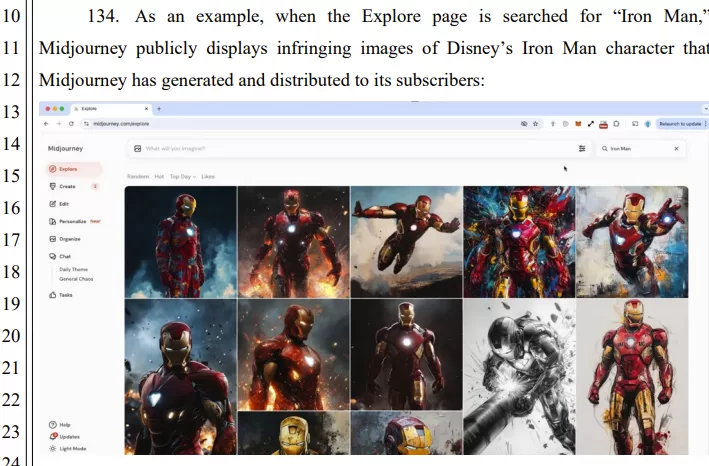
This omission forms the basis for the secondary infringement claim. Even if the platform doesn’t author the final output, the plaintiffs argue, it enables, profits from, and fails to prevent systemic misuse, while maintaining full control over how the system responds to prompts.
The companies also mention the Midjourney’s awaited AI video service, currently in development. The plaintiffs allege the same copyrighted materials are being used for training, putting the next phase of content generation on a collision course with IP law before it even launches.
In the Gallery: What Counts as Infringement?
At the heart of this case is an uncomfortable question: how close is too close?
The complaint doesn’t merely allege that Midjourney’s outputs are inspired by protected works. It insists that the model reproduces distinct visual identities such as character designs, poses, and composition styles that constitute direct infringement. To support that, Disney and Universal provide dozens of image pairs in the complaint, some using screenshots, others with AI-generated results responding to precise prompts. The examples include:
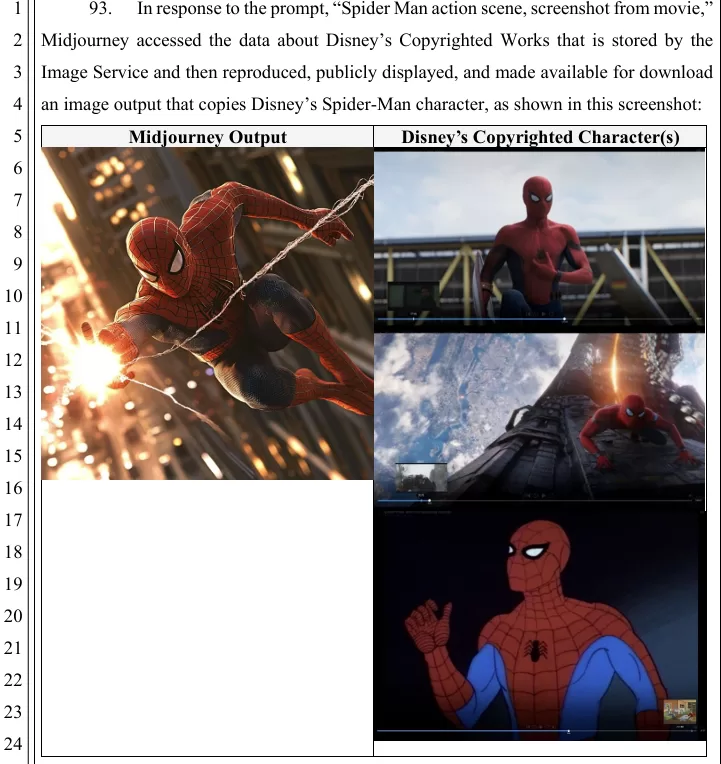
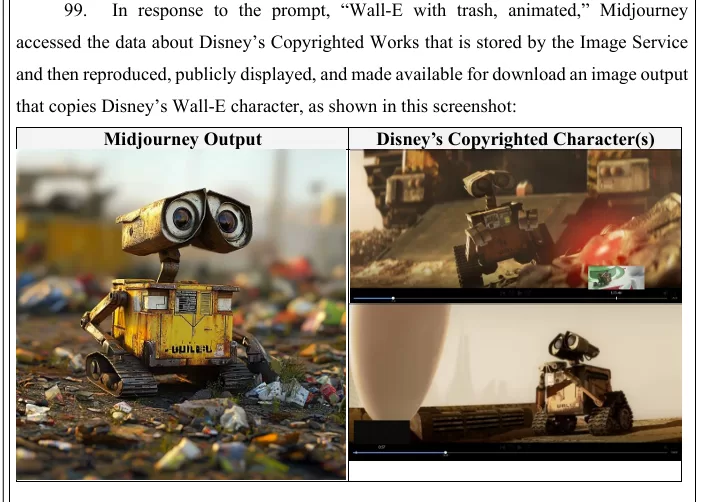
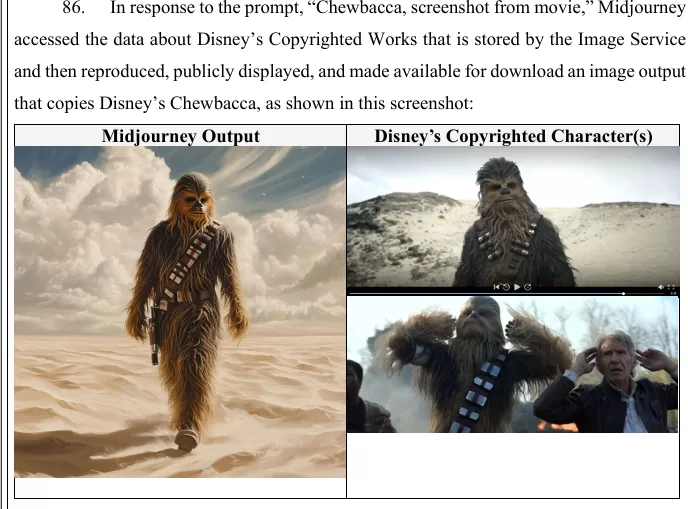
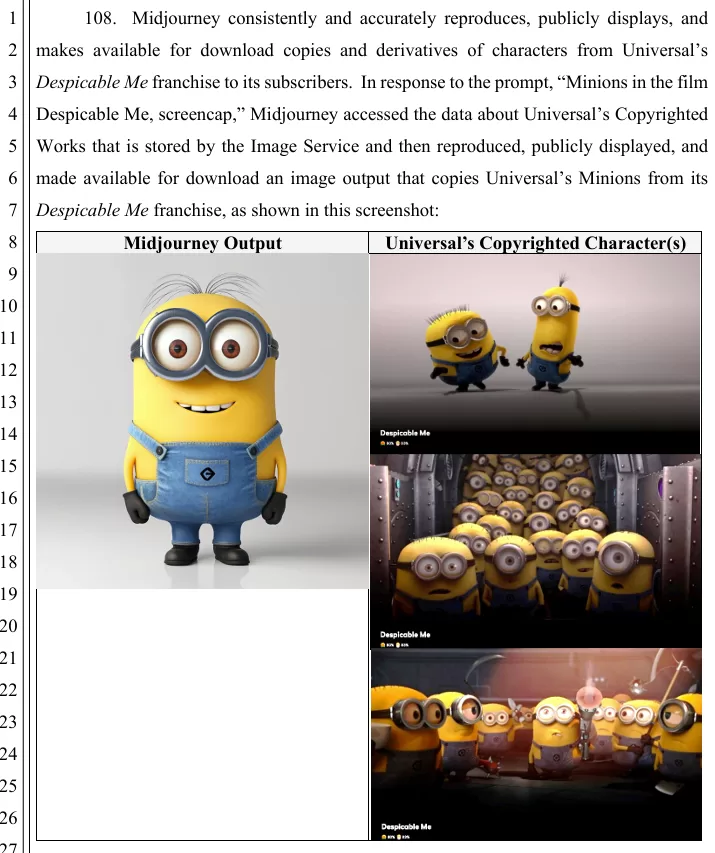
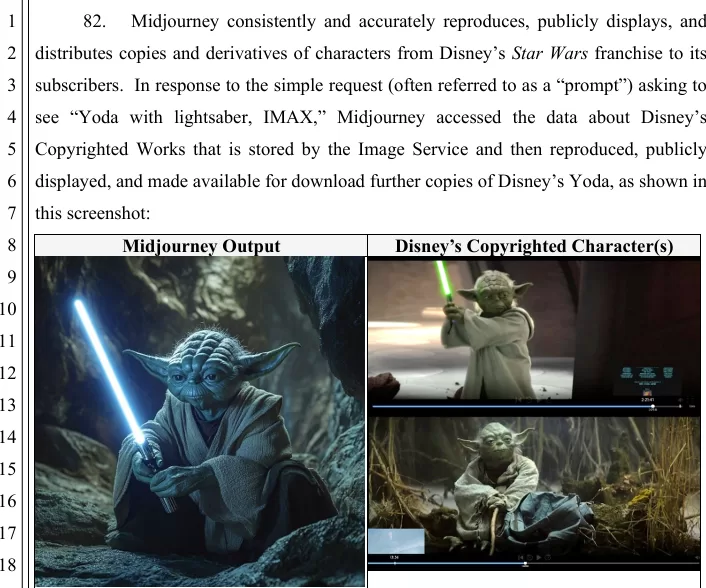
The images are presented as clear-cut: Midjourney outputs characters whose features, posture, expression, and even colour schemes mimic protected originals down to recognizable identifiers. The complaint emphasizes that these characters (Elsa, Bart Simpson, Groot, Po, among others) are not merely illustrations. They are intellectual properties whose visual expression is legally protected as part of the larger copyrighted work.
According to the plaintiffs, even when stylized or altered by users through prompts (e.g., “Pixar characters in cyberpunk Tokyo”), the underlying structure and trade dress of the characters remains intact. In this view, a “Minion in leather” or a “Goth Homer Simpson” is not transformative, it’s like a illegal candy wrapped in a new paper.
The legal framing rests heavily on the statutory definition of a derivative work under 17 U.S.C. § 101: “a work based upon one or more preexisting works.” That includes any work that “recasts, transforms, or adapts” the original in any fixed medium. The plaintiffs assert that Midjourney’s outputs, even when stylized or hybridized, qualify as unauthorized derivatives.
This interpretation has serious consequences. If courts adopt this standard — where generating any visually recognizable version of a copyrighted character constitutes infringement — the implications could ripple far beyond Midjourney, hitting platforms like DALL·E, Runway, and Sora, along with users and commercial clients.
But that line is not settled law. There is still no judicial consensus on whether an AI-generated image that resembles a copyrighted character, but is built from synthetic layers, constitutes infringement — especially if the output is a composite of probabilities rather than pixel-for-pixel copies.
For the studios, the stakes are control. For Midjourney, it may come down to whether generative systems can be allowed to imitate — without ever duplicating — what the public can already describe.
The Plaintiffs’ Framing: Creators vs. Copyists
To Disney and Universal, this case is not about defending a handful of characters, but about defending the monopoly on our childhood memories, on which I agree with creator Levi Hildebrand -check out his Youtube video on the Disney Worlds.
The studios describe Midjourney as a commercial enterprise that knowingly built itself atop their creative legacy, bypassing the legal and financial obligations that support the industry.
The complaint leans heavily on rhetoric: Midjourney is called a “bottomless pit of plagiarism,” a “bootlegging business,” and a threat to “the bedrock incentives of U.S. copyright law.”
The studios present themselves as champions of innovation under rules: the very companies that pioneered animation, computer graphics, and now machine learning in de-aging actors. What they reject is the notion that these same technologies can be used against them and to automate their outputs without compensating the human labour and intellectual property behind them.
They argue that Midjourney’s refusal to implement copyright filters, despite implementing moderation for adult content, is evidence of intentional misconduct. According to the lawsuit, Disney and Universal directly requested technical safeguards before litigation, and were ignored.
What’s at stake, they argue, is not only the protection of iconic characters like Elsa or the Minions, but the continued viability of licensing, franchising, and original creation as business models. If anyone can prompt a convincing version of Buzz Lightyear or Shrek on demand, what happens to the incentive to create the next one?
Midjourney’s Position
At the time of writing, Midjourney has not filed a public response to the complaint. Based on precedent, public statements by the company’s leadership, and broader trends in generative AI litigation, the shape of Midjourney’s likely defense is already visible. Let’s look into some stances Midjourney can take:
- Fair Use and Transformative Output
First and foremost: fair use. Midjourney will likely argue that its model outputs are not direct reproductions but transformations, created through a generative process that mixes millions of inputs to produce new, synthetic results. Unlike a bootleg DVD or a counterfeit T-shirt, the outputs are algorithmically composed, not manually traced.
Key to this claim is the idea that:
- No copyrighted image is ever reproduced verbatim,
- Outputs depend on user prompts (not Midjourney itself)
- The model “learns” patterns, styles, and associations, rather than storing and reproducing files.
- The Prompter Made Me Do It
Another likely line of defense: Midjourney may position itself as a passive platform, akin to YouTube or Reddit, like a neutral conduit through which users generate content. According to this framing, it is the users, not Midjourney, who craft the prompts that result in infringing images.
But this argument is slightly eroding. The Disney/Universal complaint emphasizes exactly that: Midjourney did not merely host user content, but it engineered and marketed a system that invites prompts like “Iron Man in the desert, cinematic lighting,” and uses the resulting images to attract new subscribers.
- No Human, No Problem?
A subtler (and riskier) defense could be philosophical: the outputs are not “authored” in the human sense, and thus not subject to traditional copyright infringement. The logic here is inverse – if no one can claim copyright over a model’s image, how can anyone claim it infringes?
- It’s Style, Not Substance
Midjourney may also suggest that what’s being generated is merely style and that visual resemblance alone does not equate to protected expression. But again, the sheer specificity of the examples in the complaint weakens this claim.
The Precedents and the Stakes
Midjourney may also suggest that what’s being generated is merely style, as visual resemblance alone does not equate to protected expression.
And Midjourney is not alone. This lawsuit joins a growing stack of legal challenges aimed at the generative AI industry’s foundational practices. Namely, training on copyrighted material without license, then offering outputs that sometimes compete with the original works.
Disney and Universal’s lawsuit may be the most high-profile and visually compelling yet, but it’s an expected incoming lawsuit, considering the rising trends. None of the following lawsuits have been resolved yet. Let’s look into this lawsuit from a broader perspective, in the case of AI used for publishing, visual media, and music.
- Authors Guild v. OpenAI
Filed in 2023 and amended in 2024, this class action led by prominent novelists accuses OpenAI of training its language models on entire books. Plaintiffs argue that the models regurgitate specific passages when prompted. OpenAI, in response, has leaned heavily on fair use and the supposed “transformative” nature of training.
- Getty Images v. Stability AI
In the UK and U.S., Getty has sued Stability AI (creator of Stable Diffusion) for allegedly scraping millions of watermarked Getty photos to train its model. Getty frames this as copyright infringement and theft. Stability AI has tried to argue that the model does not store or recall specific images
- Anderson v. Meta
Less discussed but deeply important, this lawsuit was filed by a group of musicians against Meta for training its music generation models on copyrighted recordings without license. The plaintiffs argue that AI-generated music can and does mimic the stylistic fingerprints of real musicians, and that Meta’s internal documents show awareness of potential copyright exposure. If courts rule in favour of the musicians, it could force AI developers of audio models like Suno, Udio, and MusicLM to license music datasets pre-emptively.
To say, one mutual thing all lawsuits share is some form of alleged copyright violation.
What does everyone want, exactly?
The courts now face the question: does generating anything already known or recognizable, even through synthetic and probabilistic processes, cross the line into infringement? The answer will not only determine the outcome of Disney and Universal’s case against Midjourney, but will also set the tone for a wave of ongoing lawsuits mentioned before. Together, these cases will define the legal boundaries of how generative AI can be trained, what it can reproduce, and who bears responsibility for its outputs. The decisions reached in this cycle of litigation will shape how AI models are built, what data they can legally ingest, and whether the current architecture of the generative AI industry remains viable at all.
For generative AI companies, the outcome will define liability and feasibility. If courts side with the plaintiffs, platforms may be forced to overhaul their models, retrain on curated and licensed data, or implement aggressive filtering systems that limit creative range for users.
For the studios, the stakes are about retaining control over their intellectual property and the business models built around it. It is also important to acknowledge that Disney, perhaps more than any other studio, holds a unique position in our collective imagination. Its characters and stories are cultural artifacts, even to the emotional childhood memories across generations of watching movies and cartoons. Behind the warmth however, the legacy comes with a long-standing legal posture. Disney has historically enforced its intellectual property with extraordinary rigor, often extending legal action to fan creators, schools, and small businesses that even lightly borrow from its fantasy worlds.
The company’s position is clear: no one profits from its icons but Disney itself. This latest lawsuit, just scaled to the AI era, continues that tradition.
Since this is already getting very complicated, in our next article, we’ll explore what these legal battles mean for everyone involved – from developers and artists to policymakers and everyday users. We’ll take a closer look at questions such as:
- How much does a model “remember”? We’ll examine the technical implications of IP address logging, prompt tracking, and model output traceability. Can platforms like Midjourney reasonably deny accountability for what their systems generate?
- What does legal precedent look like in this space? With multiple overlapping lawsuits in progress, we’ll explore how a decision in one domain (e.g., image generation) could cascade into others (text, music, video).
- What happens to the generative AI industry if it loses? We’ll look at potential outcomes: forced licensing regimes, closed-source model mandates, or content provider blacklists. How will that reshape innovation and access?
- And on the other side, what happens to the media industry if it wins? We’ll weigh the risks of overreach, creative gatekeeping and whether powerful IP holders will set rules that might set back new forms of expression.

[…] Book Bonfire LawsuitJul 01: Can Claude Run a Business? A Critical Look at Anthropic’s Project VendJun 17: Lawsuit Case Analysis: Disney & Universal v. Midjourney – The Empire Strikes AIJun 12: A Critical Review of Apple’s LLM Research on Reasoning ModelsJun 02: How did we get from […]
[…] Book Bonfire LawsuitJul 01: Can Claude Run a Business? A Critical Look at Anthropic’s Project VendJun 17: Lawsuit Case Analysis: Disney & Universal v. Midjourney – The Empire Strikes AIJun 12: A Critical Review of Apple’s LLM Research on Reasoning […]
[…] Skip to contentAug 26: EU AI Act in Force: Comprehensive overview on implications for GPAI providers, creators and copyright regulationJul 16: Take it up with MidJourney, not me: How Copyright Overreach and Corporate Hypocrisy Punish Independent ArtistsJul 07: Generative AI vs. Copyright: From Disney’s Silence to Anthropic’s Book Bonfire LawsuitJul 01: Can Claude Run a Business? A Critical Look at Anthropic’s Project VendJun 17: Lawsuit Case Analysis: Disney & Universal v. Midjourney – The Empire Strikes AI […]
[…] I covered Disney and Universal v. Midjourney earlier this year, I argued that these lawsuits were not fringe distractions but existential […]
[…] training Midjourney’s AI systems and in the outputs generated by users. The case, as detailed by AI Connect Network, centered on the platform’s ability to create images “substantially similar” to copyrighted […]